
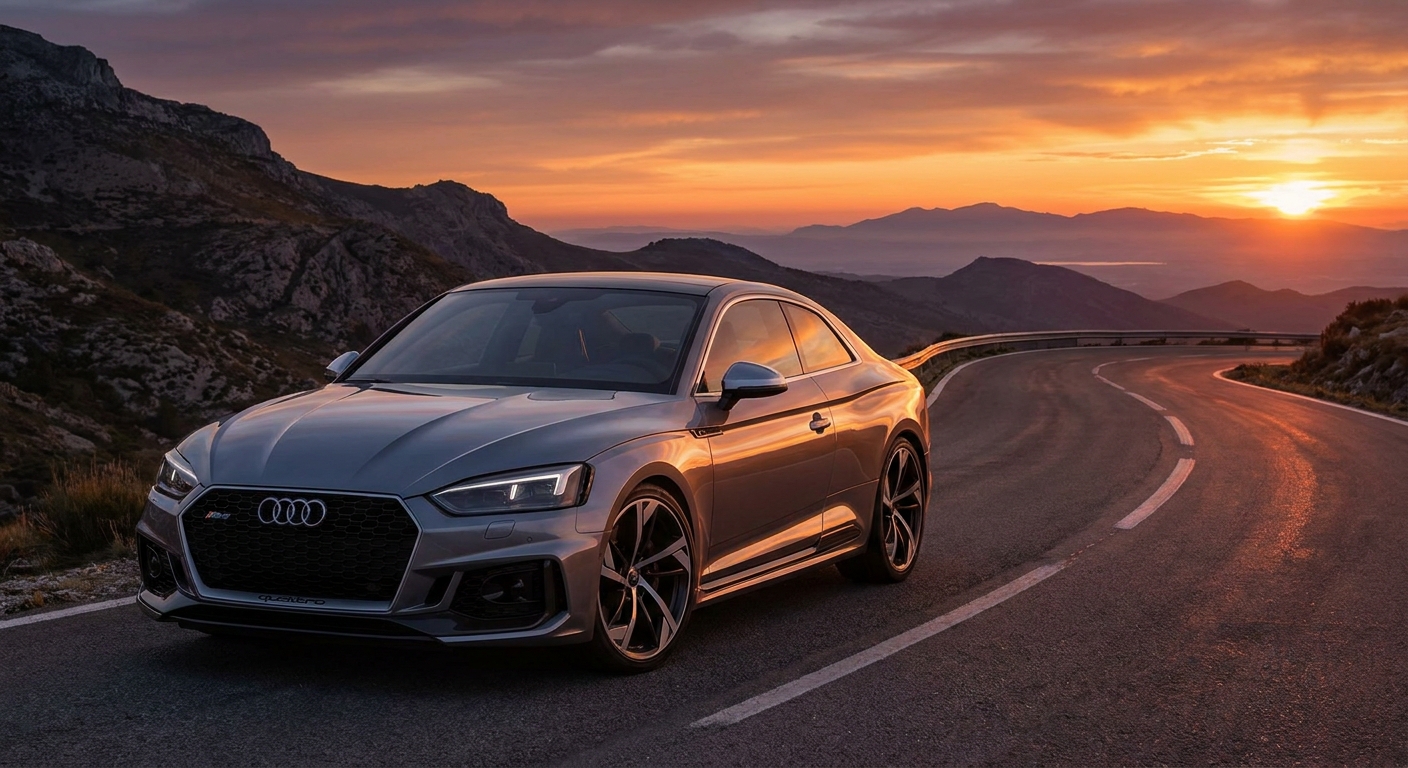
Why the audi rs5 is the Ultimate Daily Performance Machine
Look, I finally got the keys to an audi rs5, and let me tell you straight up, it completely flips the script on what a daily drivable performance car should actually feel like. If you want a machine that bridges the gap between raw track aggression and luxurious highway cruising, you are looking at the crown jewel right here. Just last week, I took this exact model on an epic road trip from the chaotic, bustling streets of Kyiv straight down to the twisting, unpredictable mountain roads of the Carpathians. Driving through heavy rain near Yaremche is usually a nightmare in a high-horsepower coupe, but the way the legendary all-wheel-drive system grips the damp asphalt is nothing short of pure magic. You literally feel planted to the ground, no matter what the weather throws at you. The thesis here is simple: you don’t have to sacrifice comfort to get supercar-level acceleration. The suspension tuning, the cabin acoustics, and the sheer predictability of the chassis make it the smartest choice for anyone who actually wants to drive their sports car every single day without breaking their back. Let’s break down exactly why this car demands your attention.
The Core Benefits: Why It Beats the Competition
When you put your hard-earned money down for a high-end coupe, you want undeniable value. The beauty of this platform is that it offers a dual personality. On one hand, you have a plush, tech-heavy cabin that makes a three-hour commute feel like a breeze. On the other hand, you have a twin-turbocharged monster waiting to be unleashed with a tap of your right foot. To really understand the value proposition, think about two totally different scenarios. Example one: you are picking up friends or family in the Sportback version. They have plenty of legroom, the ride is buttery smooth in Comfort mode, and the trunk easily swallows all your luggage. Example two: it is early Sunday morning, you find an empty backroad, switch the drive select to Dynamic, and suddenly the steering tightens, the exhaust valves open, and the car transforms into a precision weapon. It is two completely different vehicles wrapped in one beautiful shell.
| Feature Category | RS5 Coupe Spec | RS5 Sportback Spec |
|---|---|---|
| Practicality & Doors | 2 Doors, Moderate Rear Space | 4 Doors, Excellent Rear Space |
| 0-60 mph Acceleration | 3.7 Seconds (Est) | 3.8 Seconds (Est) |
| Cargo Capacity | 10.9 cubic feet | 21.8 cubic feet |
Here are three massive reasons why you should pick this over its closest rivals from Munich or Stuttgart:
- All-Weather Usability: Unlike rear-wheel-drive competitors that stay parked when it snows or rains heavily, this beast thrives in bad weather thanks to its sophisticated drivetrain.
- Refined Interior Aesthetics: The cabin is a masterclass in minimalism and quality. Carbon fiber trim, Nappa leather with honeycomb stitching, and tactile physical buttons give it a premium edge.
- Instant Usable Torque: You do not need to rev the engine to the moon to get moving. The twin-turbo setup delivers a massive punch of torque low in the RPM range, making city passing effortless.
The Rich History and Legacy
The Origins of the RS Lineage
You cannot talk about fast Audis without paying respect to where it all started. Back in the day, the brand built its reputation in the dirt and gravel of Group B rallying. But translating that wild rally pedigree to the street took a special partnership. In the early 90s, they teamed up with Porsche to create the legendary RS2 Avant. That was the blueprint: take a practical, everyday vehicle, slap a massive turbo on it, beef up the suspension, and send the power to all four wheels. That philosophy has trickled down through the decades directly into the DNA of the coupe we are talking about today.
The Evolution of the V8 to V6
If you have been around the car scene for a while, you probably remember the previous generation, the glorious B8. That car had a naturally aspirated 4.2-liter V8 engine that revved past 8,000 RPM. It sounded like an absolute symphony. However, emissions regulations and the relentless pursuit of efficiency forced a major change. Moving to the B9 generation, the engineers dropped the V8 for a 2.9-liter twin-turbo V6. While purists initially panicked, the new engine proved to be vastly superior in daily driving scenarios. It produces significantly more torque at much lower RPMs, meaning you get shoved back into your seat much quicker without having to ring the car’s neck.
The Modern State of Performance in 2026
Right now, in the year 2026, the performance landscape is heavily leaning towards full electrification. Yet, the current iteration of this car stands out as a beautiful reminder of peak internal combustion engineering. The integration of mild-hybrid systems has smoothed out the auto start-stop functions and improved fuel efficiency slightly, but the heart of the car remains beautifully analog in its power delivery. It feels like a refined, perfected version of everything the brand has learned over the last thirty years of building fast cars.
Decoding the Technical Engineering
Understanding the 2.9L TFSI Engine
Let’s get a bit nerdy about what is actually happening under the hood. The 2.9-liter V6 isn’t just an ordinary engine; it features a ‘hot V’ configuration. What does that mean? Instead of mounting the twin turbochargers on the outside of the engine block, they are tucked right inside the valley between the two cylinder banks. This drastically shortens the distance the exhaust gases have to travel to spool up the turbos. The result? Turbo lag is practically nonexistent. The moment you press the pedal, the boost builds instantly. It is paired with an 8-speed ZF automatic transmission. While some folks miss the older dual-clutch boxes, the ZF 8-speed can handle the massive torque output much more reliably while still firing off incredibly crisp shifts.
Mastering the All-Wheel Drive Dynamics
The magic trick of this car is the sport rear differential. Standard systems just brake the inside wheel during a turn to help you corner. The sport differential actively pushes more power to the outside rear wheel, literally shoving the nose of the car tightly into the apex. It completely masks the weight of the car, making a heavy grand tourer feel like a lightweight sports car.
- Engine Output: A staggering 444 horsepower under standard tune.
- Peak Torque: 442 lb-ft available from just 1,900 RPM.
- Boost Pressure: The twin turbos push up to 21.5 psi of boost.
- Braking System: Optional carbon-ceramic front brakes for zero fade during aggressive canyon runs.
The 7-Day Ownership Experience Plan
Thinking about pulling the trigger? Here is exactly what your first week with this incredible machine will look like. I have mapped out a 7-day plan to help you fully explore every single aspect of the car safely and thoroughly.
Day 1: The Initial Handover and Visual Walkaround
Spend your first day just taking it in. Notice the massively blistered wheel arches—a direct homage to the original Quattro race cars. Sit in the cabin, adjust the aggressive side bolsters on the sport seats, and get your driving position absolutely dialed in. First impressions matter, and the build quality here is staggering.
Day 2: Mastering the MMI Infotainment
Before you start driving fast, learn the tech. Sync your phone, set up the wireless Apple CarPlay, and customize the Virtual Cockpit. I highly recommend switching the digital dash to the specific ‘RS Performance’ view, which puts a massive tachometer right in the center of your screen.
Day 3: The Commuter Test
Take it to work. Leave it in Comfort mode. Notice how the adaptive dampers soak up potholes and expansion joints. The cabin insulation is remarkably thick, blocking out wind and tire noise. It is genuinely as comfortable as a standard luxury sedan.
Day 4: Backroad Carving
It is time to find some twisty roads. Switch over to Dynamic mode. Feel the steering weight increase. Keep the transmission in manual mode and use the paddle shifters to keep the revs high. Notice how the sport differential practically eliminates understeer when you power out of tight corners.
Day 5: Testing the Quattro System
If you can safely find a gravel road or a rain-soaked empty parking lot, carefully feel how the all-wheel drive shifts power. It is rear-biased under normal driving (sending about 60% of power to the rear), giving it a playful, sporty feel while maintaining ultimate safety.
Day 6: The Launch Control Experience
Find a safe, closed stretch of asphalt. Put the car in its most aggressive settings, turn traction control to sport, hold the brake firmly with your left foot, and pin the gas with your right. The revs will hold around 3,500 RPM. Release the brake, and prepare to have the breath knocked out of your lungs as you hit 60 mph in under four seconds.
Day 7: The Final Verdict on Fuel Economy
Check your trip computer. Surprisingly, if you behaved yourself on the highway, you will likely see high 20s for MPG. Wash the car, admire the aggressive lines, and realize you bought the perfect all-rounder.
Shattering the Myths
There is a lot of misinformation out there on the internet forums. Let’s clear the air and debunk some common nonsense.
Myth: The car is way too heavy to handle well on a track.
Reality: While it isn’t a stripped-out track toy, the chassis engineering and active torque vectoring completely hide the curb weight. It rotates into corners far better than the spec sheet implies.
Myth: The V6 engine sounds boring compared to the old V8.
Reality: Sure, it doesn’t scream to 8,000 RPM, but the optional sport exhaust system brings a ton of character. It gives deep, bass-heavy rumbles and fires off aggressive pops and bangs on downshifts.
Myth: It is just an A5 with a tune.
Reality: Absolutely false. The suspension geometry, the widened track, the reinforced chassis bracing, and the entirely bespoke engine make it a completely different animal dynamically.
FAQ & Final Thoughts
Is this vehicle considered a true supercar?
No, it is technically a high-performance grand tourer, but its acceleration numbers rival supercars from just ten years ago.
What is the absolute top speed?
It is electronically limited to 155 mph from the factory, but if you opt for the Dynamic package, the limiter is raised to an impressive 174 mph.
Does it have wireless Apple CarPlay?
Yes, the latest MMI system includes fast, responsive wireless Apple CarPlay and Android Auto integration.
How reliable is the 2.9 twin-turbo engine?
It is incredibly robust. As long as you keep up with the scheduled maintenance, frequent oil changes, and let the oil come up to temperature before driving hard, it will easily run into high mileage.
What type of fuel does it require?
You absolutely must use premium unleaded 93 octane (or 98 RON) to get the advertised horsepower and keep the engine safe from knocking.
Is the ride quality too stiff for a daily driver?
Not at all. The adaptive suspension system provides excellent compliance in its softest setting, making it perfectly comfortable for terrible city roads.
Can I fit a baby car seat in the back?
If you buy the Sportback model, absolutely. The four-door configuration offers excellent rear legroom and easy access for child seats.
How much does a brake job cost?
Steel brakes are relatively standard for luxury sports cars, but if you have the carbon-ceramic option, a full replacement can be very expensive, though they last significantly longer.
So, there you have it. You have seen exactly what makes this machine tick, from its rally-inspired roots to its modern, blisteringly fast reality. If you are looking for a vehicle that can commute perfectly on Monday and set lap records on Sunday, this is your answer. Do not just take my word for it—get out to your local dealer, book a test drive, and experience the thrill for yourself!

Leave a Reply