
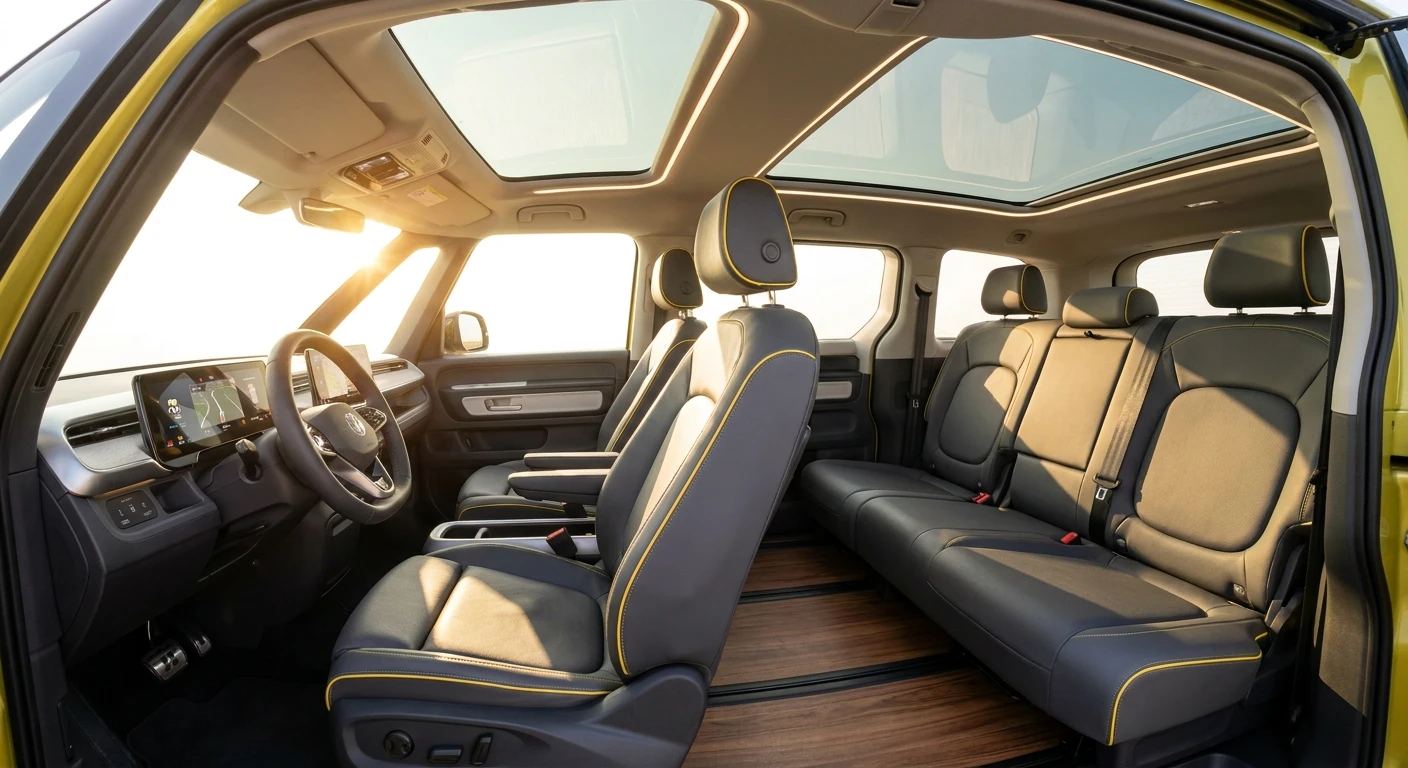
Discovering the VW ID Buzz Interior
Stepping inside the VW ID Buzz interior reveals a massive and fundamental shift in how modern automakers approach electric vehicle cabins. Designed to meticulously blend retro nostalgia with cutting-edge futuristic minimalism, this cabin completely redefines the standard for family haulers and active lifestyle vehicles alike. You are looking at a highly optimized space that prioritizes airiness, sustainability, and seamless digital integration over the cluttered dashboards of the past century. The overarching thesis is remarkably simple yet highly effective: Volkswagen has created a mobile living room that maximizes everyday utility without ever sacrificing aesthetic appeal. Instead of simply fitting batteries under a traditional combustion floorpan, engineers brilliantly utilized the MEB platform’s perfectly flat floor to push the wheels to the absolute extreme corners, unlocking unprecedented interior volume. As global electric mobility matures, consumers demand significantly more than just impressive driving range; they want a comfortable, highly intuitive environment for daily commutes. This cabin delivers exactly that, beautifully merging recycled materials with smart, hidden storage solutions. Expect sweeping horizontal design lines, playful and vibrant color schemes, and massive glass areas that generously flood the cabin with natural sunlight. Whether you need a practical cargo workhorse or a highly comfortable space for cross-country road trips, thoroughly understanding the dimensions and exclusive features of this cabin helps clarify exactly why it stands out so prominently in the heavily crowded EV market.
Understanding the core functional appeal of the cabin deeply requires closely looking at how Volkswagen balances passenger comfort with raw, uncompromised utility. The ultimate value proposition here is unmatched spatial flexibility—a unique space that transitions absolutely seamlessly from a quiet passenger sanctuary to a heavy-duty, flat-loading cargo hauler in mere seconds. For example, simply folding the rear seats turns the van into a cavernous transport vehicle capable of carrying large furniture, while keeping them fully upright provides executive-level legroom for tall adult passengers. Another fantastic example is the modular center console, affectionately dubbed the Buzz Box, which can be easily unlatched and entirely removed to create a completely clear, flat walkway between the front driver and passenger seats.
Read also: Why the kia carnival 2022 Rules; The 2026 Corolla: Complete Review, Specs, and Features; The Ultimate equinox 2024 Buyer Guide.
To fully grasp the complexity and layout of this vehicle, meticulously review the primary material and space configurations currently available to buyers:
| Feature Category | Standard Configuration | Premium Upgrade Configuration |
|---|---|---|
| Seat Upholstery Materials | Recycled ArtVelours ECO Microfleece | Premium Vegan Leather Substitute with Stitching |
| Cabin Ambient Lighting | 10-color standard adjustable lighting | 30-color multi-zone adjustable ambient lighting |
| Maximum Seating Capacity | 5-seat standard wheelbase layout | 7-seat long wheelbase (LWB) layout |
Maximizing the absolute utility of this highly engineered space requires knowing precisely how to configure the various seating and storage options. Carefully follow these fundamental steps to completely optimize the cabin environment for any journey:
- Slide the heavy-duty second-row seats forward or backward by up to 5.9 inches to perfectly balance passenger legroom with rear cargo capacity based on your immediate daily needs.
- Remove the multi-function Buzz Box from the front row and easily click it into the rear passenger floor area to provide the kids with a built-in table and ice scraper storage during long trips.
- Fold down the split-folding rear seats and deploy the false floor mechanism to create a completely flat loading floor, perfect for easily sliding in long items like surfboards, camping gear, or heavy flat-pack furniture.
- Program and activate the highly customizable ambient lighting zones through the infotainment screen to significantly reduce eye strain during night driving while keeping the floor area safely illuminated for all passengers.
Origins of the Classic Microbus Layout
The overall spatial philosophy behind this remarkably modern electric van traces its architectural roots directly back to the original Volkswagen Type 2, famously known worldwide as the Microbus or Kombi. In the early 1950s, ambitious engineers realized that by creatively placing the combustion engine at the extreme rear and pushing the driver forward directly over the front axle, they could maximize the usable interior volume on a surprisingly minimal footprint. This iconic cab-over design created a cavernous interior that instantly made the classic bus an absolute legend among travelers, tradespeople, and large families. The primary goal was always squarely about prioritizing the people inside the box rather than focusing on the heavy mechanical components outside of it.
Evolution into the Advanced Electric Era
Moving forward into the 21st century, strict global safety regulations and rigorous crash testing essentially killed the traditional cab-over design, permanently forcing a prominent front crumple zone onto all modern vans. However, the massive global shift to electric vehicle architecture provided a brilliant new opportunity to reclaim this philosophy. By precisely placing the heavy battery pack flat beneath the floorboard and utilizing highly compact electric motors on the axles, visionary designers managed to reclaim that lost cabin space. The complex transition from internal combustion to the dedicated MEB electric platform meant absolutely no center transmission tunnel, no bulky exhaust pipe routing, and no massive metal engine block intruding heavily into the front firewall. This technological evolution allowed the digital dashboard to be pushed significantly further forward, perfectly recreating the airy, open, and spacious feeling of the classic Type 2 without ever compromising modern crash safety standards.
Modern State of the Digital Cabin
Today, the modern iteration clearly represents the absolute pinnacle of automotive space efficiency. It beautifully retains the two-tone color heritage and expansive glass greenhouse of its famous ancestors but completely replaces outdated analog dials with sleek, floating digital displays. The interior designers successfully captured the warm emotional resonance of the original bus while strictly implementing entirely animal-free, sustainable materials throughout the space. Recycled ocean plastics and recovered PET water bottles now directly form the soft headliner, door panels, and seat covers, beautifully bridging the gap between nostalgic retro charm and critical contemporary ecological responsibility.
Acoustic Engineering and Advanced Thermal Management
Designing electric vehicles presents a highly unique challenge for acoustic cabin designers: without the droning, constant background noise of a traditional internal combustion engine, high-speed wind buffering and rough tire noise become glaringly obvious to passengers. To effectively counteract this phenomenon, automotive engineers implemented highly advanced acoustic dampening technologies throughout the entire aluminum and steel chassis. They strategically utilized specialized sound-absorbing foam materials inside the hollow wheel arches, lower door panels, and main floor panels to aggressively block high-frequency tire roar from entering the space. Furthermore, the specialized acoustic windshield features an ultra-thin layer of polyvinyl butyral (PVB) securely sandwiched between the outer glass panes, specifically tuned at a molecular level to intercept and completely neutralize wind noise turbulence at high highway speeds.
Proper thermal management is equally crucial for sustaining passenger comfort and maximizing battery efficiency. A highly efficient, pressurized heat pump system continuously captures waste heat generated from the electric drivetrain and external ambient air, rapidly compressing it to effectively warm the cabin space. This complex process drastically reduces the electrical energy drawn directly from the main battery pack, significantly preserving the vehicle’s maximum driving range during freezing winter conditions.
Ergonomics and Haptic Interface Architecture
The entire dashboard layout heavily relies on sophisticated haptic feedback interfaces rather than utilizing traditional mechanical buttons or heavy switches. The sensitive capacitive touch sliders precisely control the cabin temperature and audio volume, requiring only a very light, deliberate swipe from the user’s finger. Beneath the glossy surface, micro-piezoelectric actuators instantly provide a subtle, mechanical-feeling physical click to definitively confirm the digital input, drastically reducing the cognitive load on the driver.
- The primary central infotainment display heavily utilizes a hidden infrared proximity sensor that automatically enlarges digital icons as a human hand approaches, making complex menu selections significantly easier while driving at speed.
- The contoured steering wheel features embedded capacitive wire sensors that constantly detect human skin contact, ensuring the driver’s hands remain securely on the wheel during active semi-autonomous highway travel.
- The climate control software incorporates a highly intelligent Smart Climate function that automatically targets conditioned airflow directly at occupants’ bodies based entirely on weight and seat occupancy sensors.
- The internal seat foam density is scientifically mapped using pressure sensors to drastically reduce pressure points on the lower back, utilizing variable firmness zones to measurably improve blood circulation over exceptionally long journeys.
- The massive panoramic smart glass roof securely uses advanced electrochromic technology, instantly applying a low-voltage electrical current to liquid crystals to switch the glass pane from fully transparent to completely opaque.
Configuring this advanced electric van for a long weekend trip requires a highly systematic approach to ensure maximum comfort. Follow this comprehensive 7-step guide to perfectly dial in your custom environment.
Step 1: Calibrate the Primary Driver Seat Ergonomics
Start by meticulously adjusting the 12-way power driver seat. Ensure your hips are positioned slightly higher than your knees to promote blood flow, and precisely adjust the pneumatic lumbar support to completely fill the natural inward curve of your lower back for optimal, pain-free posture.
Step 2: Sync the Digital Cockpit Profile
Carefully log into the main central infotainment system using your unique Volkswagen ID digital profile. This automated action immediately retrieves your saved exterior mirror angles, favorite radio stations, and specific digital gauge cluster layout, saving you from manually adjusting them every single time you enter the vehicle.
Step 3: Position the Modular Center Buzz Box
Decide exactly where the center console will live for the duration of the trip. For a road trip with adults, securely lock it directly between the front seats for easy access to the cup holders. If you desperately need floor space to easily access the rear cabin, quickly unlatch it and safely stow it in the rear cargo hold.
Step 4: Configure the Second-Row Bench Seating
Slide the heavy rear bench forward on its metal rails to instantly maximize rear trunk space for heavy, bulky luggage, or push it all the way back into the cabin to provide absolute limousine-like legroom for exceptionally tall passengers. Ensure the rear seatbacks are properly reclined to a highly comfortable angle.
Step 5: Dial in the Smart Climate Comfort Zones
Use the convenient natural voice command Hello ID, my hands are freezing to automatically activate the rapid steering wheel heater. Meticulously set the multi-zone digital climate control so the rear passengers have their own completely independent fan speed and temperature settings.
Step 6: Customize the Interior Ambient Lighting Modes
Navigate deeply into the digital lighting menu and carefully select from the 30 available color spectrums. Choose a cool, calming blue or soft green for daytime driving to create a relaxing atmosphere, or quickly switch to a warm, soft amber at night to significantly reduce eye fatigue.
Step 7: Optimize Rear Cargo Tie-Downs and Storage
Firmly secure any loose, rolling items in the trunk using the deeply integrated metal floor hooks and the elastic cargo net. If you are actively utilizing the false floor load management system, carefully hide your bulky charging cables underneath the panels to absolutely keep the primary loading area completely unobstructed and clean.
Myth: The cabin feels incredibly cheap and hollow because it uses recycled plastics instead of traditional genuine cowhide leather.
Reality: The scientifically engineered recycled materials, such as the ArtVelours ECO microfleece, are meticulously designed to provide a highly premium, soft-touch feel that perfectly mimics high-end suede. It is highly durable and visually luxurious, proving definitively that environmental sustainability does not mean compromising on comfort.
Myth: The capacitive touch-sensitive sliders are absolutely impossible to use safely while actively driving.
Reality: While they admittedly take a brief adjustment period to master, the capacitive sliders are deeply grooved to naturally guide your fingers without looking, and advanced voice commands handle almost all climate and audio functions instantly, minimizing the need to ever look away from the road.
Myth: The total lack of a traditional, massive physical instrument cluster makes the dashboard look empty and unfinished.
Reality: The compact, floating 5.3-inch digital driver display provides absolutely all essential speed, battery, and navigation data perfectly within the direct line of sight, effectively creating an uncluttered, distraction-free environment that significantly improves forward driving visibility.
Myth: The completely flat floor design inherently makes the driving seating position awkward and uncomfortable.
Reality: The elevated, van-like command seating position actually offers excellent, supportive thigh support and a remarkably commanding, highly visible view of the road ahead, far superior to traditional low-slung, cramped sedans.
Does it offer optional third-row seating?
Yes, the newly introduced long-wheelbase (LWB) model features a highly practical folding third row, safely bringing the total maximum seating capacity to seven adult passengers.
Are the rear passenger side windows fully functional?
No, the standard rear side glass windows are firmly fixed in place, though small mechanical sliding window inserts are occasionally available on certain specific trims and global markets.
Can the rear seats be completely removed from the cabin?
The third-row seats in the LWB model can be effortlessly removed completely, while the heavy second-row bench folds flat but firmly remains permanently attached to the floor rails.
Is there a front trunk (frunk) for extra storage?
No, the short front compartment exclusively houses vital climate control hardware and electronic components, so absolutely all cargo storage is efficiently located in the rear cabin.
Does the steering wheel still use actual physical buttons?
The steering wheel currently primarily uses haptic touch-sensitive glossy pads, though Volkswagen has announced that some future trims are actively transitioning back to reliable physical buttons due to customer feedback.
What is the maximum cubic capacity of the rear cargo area?
The standard wheelbase model impressively offers approximately 39.6 cubic feet of usable space directly behind the upright second row of seats.
Does the infotainment screen have Apple CarPlay and Android Auto?
Yes, highly reliable wireless Apple CarPlay and wireless Android Auto are completely fully integrated into the standard digital infotainment operating system.
Is the electrochromic panoramic glass roof a standard feature?
The massive electrochromic panoramic smart glass roof is an optional, premium upgrade, usually reserved exclusively for higher, more expensive trim levels.
In conclusion, thoroughly exploring the VW ID Buzz interior reveals an absolute masterclass in highly modern automotive packaging, effortlessly blending retro aesthetics with phenomenal, everyday family practicality. If you are finally ready to significantly upgrade your daily family hauler, simply check out our latest comprehensive EV reviews to perfectly find the absolute best electric vehicle for your busy lifestyle today.

Leave a Reply