
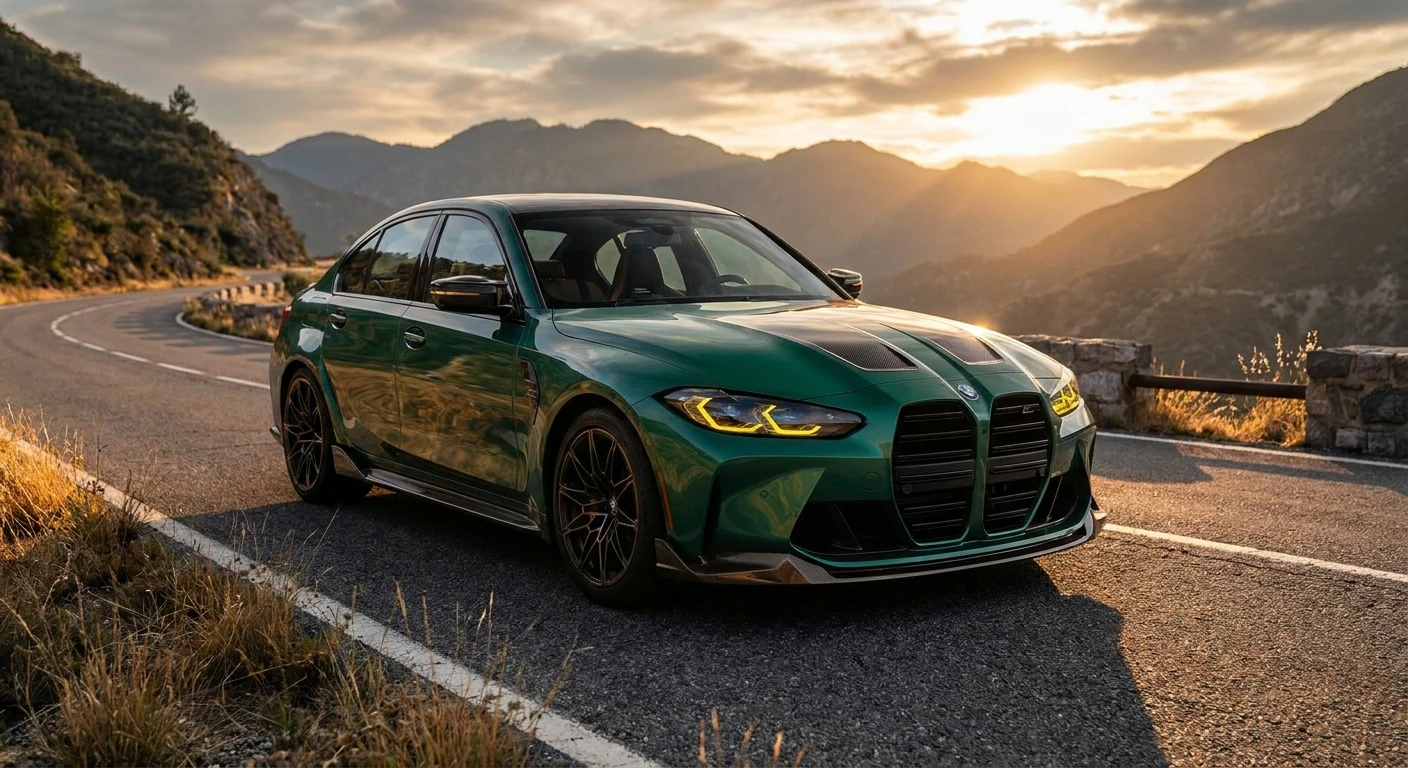
The Ultimate Reality of the BMW M3 CS Experience
Getting behind the wheel of a BMW M3 CS changes your entire perspective on what a four-door luxury sedan can achieve. You turn the steering wheel, press the throttle, and the vehicle responds with an immediacy usually reserved for purpose-built track machines. The standard M-car experience already pushes boundaries, but the Clubsport badge elevates the engineering to an extreme level. From the distinctive yellow daytime running lights paying homage to GT racing, to the aggressive exposed carbon fiber elements on the hood, the aesthetic immediately signals serious intent. The vehicle exists for drivers who demand the absolute maximum from their hardware, refusing to compromise on either straight-line speed or lateral grip.
Engineers in Munich stripped away unnecessary weight and optimized the S58 twin-turbocharged inline-six engine to deliver a staggering 543 horsepower. This output routes through a specially tuned M xDrive all-wheel-drive system, ensuring every ounce of torque translates directly into forward momentum rather than tire smoke. You get the raw aggression of a purebred sports car paired with the structural rigidity of a daily drivable sedan. It represents the pinnacle of the G80 generation, blending advanced aerodynamics, lightweight composite materials, and relentless mechanical grip. Understanding the exact capabilities of this chassis helps you maximize its potential on twisting mountain roads and closed circuits alike.
Read also: The 2025 BMW M5: A New Era of Performance; Real Talk About The bmw m4 For Driving Purists; The Ultimate Guide to the m340 Performance Sedan.
Extracting Maximum Value from the Clubsport Formula
The core benefit of choosing this specific model over the standard Competition variant lies in its sharpened focus. You pay a premium for incremental gains, but those gains completely alter the driving dynamics at the limit. The reduction in unsprung mass, stiffer engine mounts, and revised damper settings create a telepathic connection between the tires and your hands. Precision is the defining characteristic. Below is a direct comparison highlighting exactly where the performance advantages lie.
| Specification | Standard M3 Competition (xDrive) | M3 CS |
|---|---|---|
| Horsepower | 503 hp | 543 hp |
| 0-60 mph Time | 3.4 seconds | 3.2 seconds |
| Curb Weight | 3,990 lbs | Approx. 3,915 lbs |
| Top Speed (Limited) | 155 mph (180 mph optional) | 188 mph (Standard) |
This aggressive tuning translates into two distinct value propositions for owners. First, the track day enthusiast gains a vehicle that requires zero aftermarket modifications to set blistering lap times. Second, the canyon carving driver enjoys enhanced steering feedback and mid-corner stability that inspires massive confidence. To actually harness this capability, you need to understand the systems at play.
- Tire Temperature Management: The standard track-focused tires require specific heat cycling. Pushing the car before the rubber reaches optimal operating temperature results in unpredictable snap oversteer. You must monitor the digital tire temperature gauge closely during the first two warmup laps.
- M xDrive Configuration: The all-wheel-drive system offers a 4WD Sport mode that heavily biases power to the rear wheels. This setting allows for controlled slip angles on corner exit while maintaining the safety net of front-axle traction when things get overly chaotic.
- Shift Logic Adjustments: The 8-speed automatic transmission features variable shift speeds. For maximum acceleration, locking the Drivelogic system into its most aggressive third setting provides brutal, instant gear changes that keep the turbochargers spooling optimally.
Tracing the Heritage of the CS Badge
Origins of the Lightweight Philosophy
The concept of stripping weight and adding power to a standard production sedan did not happen overnight. The philosophy traces its roots back to the legendary homologation specials of the late 1980s and 1990s. While early lightweight models like the E36 M3 Lightweight focused strictly on physical weight reduction and aerodynamic aids, the true modern Clubsport ethos began taking shape with the iconic E46 M3 CSL (Coupe Sport Leichtbau). Although a coupe, that vehicle proved that a carbon fiber roof, a carbon airbox, and stripped sound deadening could create an entirely new tier of driving engagement. The success of the CSL laid the foundational blueprint for future four-door variants.
Evolution Through the F-Generation
The specific four-door Clubsport lineage formalized properly with the F80 generation in 2018. That iteration introduced the world to an aggressively tuned, limited-production sedan featuring a carbon fiber hood, unique front splitter, and a bump in horsepower. It served as a swan song for the F80 chassis, proving that a specialized, highly focused four-door could rival dedicated sports coupes on the Nürburgring. The F80 version utilized a tweaked version of the S55 engine and refined the dual-clutch transmission software, setting a new benchmark for steering precision in the electric power steering era.
Modern State of the G80 Generation
Today, the G80 iteration represents a massive leap forward in both technology and outright speed. By integrating the M xDrive system, the current vehicle solves the traction limitations that plagued earlier rear-wheel-drive only models. The modern version utilizes massive amounts of Carbon Fiber Reinforced Plastic (CFRP) not just for aesthetics, but for genuine structural rigidity and weight savings. The shift from a dual-clutch to an ultra-responsive 8-speed torque converter automatic has broadened the car’s daily usability without sacrificing track-day ferocity. It stands as a technological marvel of modern internal combustion engineering.
Scientific and Technical Deep Dive
Powertrain and Turbocharger Dynamics
At the heart of the vehicle sits the S58 3.0-liter twin-turbocharged inline-six engine, a masterpiece of modern thermal and mechanical engineering. To achieve the 543 horsepower rating, engineers increased the peak boost pressure of the two mono-scroll turbochargers from 24.7 psi to 30.5 psi. Handling this immense pressure requires specialized internal components. The cylinder head core is created using 3D printing technology, allowing for complex coolant duct routing that traditional metal casting simply cannot achieve. This advanced cooling prevents detonation under high loads. Furthermore, a forged lightweight crankshaft reduces rotating mass, allowing the engine to rev with ferocious speed while handling the massive torque output. The oil supply system utilizes two separate chambers and a computer-controlled suction pump, ensuring the engine remains perfectly lubricated even when experiencing extreme lateral G-forces on a banked circuit.
Aerodynamics and Weight Reduction
Aerodynamic efficiency and weight reduction work together to multiply the effectiveness of the power increase. The extensive use of Carbon Fiber Reinforced Plastic (CFRP) across the hood, front splitter, air intakes, mirror caps, rear diffuser, and trunk spoiler trims nearly 75 pounds off the curb weight compared to the standard all-wheel-drive model. This is not just about total weight; it is about where the weight is removed. Lowering the center of gravity drastically reduces body roll during aggressive directional changes.
- Titanium Exhaust System: Sheds 8 pounds from the rear of the vehicle while providing a sharper, more aggressive exhaust note due to the acoustic properties of the titanium alloy.
- Strut Tower Brace: A specialized cast aluminum strut tower brace increases front-end torsional rigidity, providing the driver with immediate, unfiltered feedback through the steering rack.
- Aerodynamic Balance: The carbon fiber front splitter and rear lip spoiler are wind-tunnel tested to balance downforce across both axles, preventing high-speed front-end lift on long straights.
- Unsprung Mass: Forged lightweight alloy wheels paired with optional carbon-ceramic brakes significantly reduce rotating unsprung mass, allowing the suspension dampers to react faster to road imperfections.
Actionable Plan: 7-Day Track Preparation Guide
Owning this machine means preparing it properly for closed-circuit driving. Follow this 7-day preparation menu to ensure optimal performance and safety during your next track event.
Day 1: Break-In Service Verification
Never take a fresh engine straight to the track. You must verify that the crucial 1,200-mile break-in service has been completed by a certified technician. This service involves dropping the factory break-in engine and differential oils, which contain metallic shavings from the initial component mating process, and replacing them with high-performance synthetic fluids. Check your service records before proceeding.
Day 2: Tire Inspection and Pressure Calibration
Inspect the extremely sticky track-focused tires for any uneven wear, cuts, or heat cycling degradation. Set your cold tire pressures meticulously. Because track driving generates massive amounts of heat, tires expand significantly. Starting with a slightly lower cold pressure ensures that once the tires reach their 200-degree operating window, they hit the exact manufacturer-recommended hot pressure for maximum contact patch.
Day 3: Suspension and Alignment Check
Take the vehicle to a specialized performance shop to verify the wheel alignment. For track use, you generally want slightly more negative camber on the front wheels to improve turn-in bite and reduce outer shoulder tire wear. Ensure all suspension bolts and the specialized cast-aluminum strut brace are torqued to factory specifications.
Day 4: Fluid Flush and Upgrades
Brake fluid boils under the extreme temperatures generated by heavy track braking. Flush the factory brake fluid and replace it with a high-temperature DOT 4 racing fluid. This guarantees a firm, consistent brake pedal lap after lap. Check the coolant levels in both the primary engine radiator and the secondary charge-air cooler circuit.
Day 5: M Setup Configuration
Sit in the cabin and program your M1 and M2 steering wheel buttons. Set M1 for your warm-up laps: Engine in Sport, Suspension in Sport, Steering in Comfort, and brakes in Sport. Set M2 for maximum attack: Engine in Sport Plus, Suspension in Sport Plus, 4WD Sport engaged, and traction control set to MDM (M Dynamic Mode) to allow for calculated slip angles.
Day 6: Track Walk and Visualizations
Study the specific track map. Memorize the braking zones, turning points, and apexes. High-horsepower all-wheel-drive sedans require a specific driving style: trail brake deeply to get the heavy nose pointed, then rely on the aggressive traction to rocket out of the corner earlier than a rear-wheel-drive car would allow.
Day 7: Apex Hunting and Cool Down
Execute your track day. Most critically, implement a strict cool-down protocol. After running hot laps, drive one full lap at 40% pace utilizing minimal braking. This allows ambient air to flow through the massive front intakes, cooling the titanium exhaust, engine block, and carbon-ceramic brake rotors gradually, preventing material warping.
Myths & Reality
Myth: The CS is just a standard car with an aggressive software tune.
Reality: The upgrades involve serious hardware changes. The vehicle features 3D-printed cylinder head cores, increased turbocharger boost pressure, a specialized titanium exhaust, solid ball joints in the suspension, and rigid engine mounts that fundamentally alter the physical chassis dynamics.
Myth: The rigid suspension makes it impossible to drive on regular roads.
Reality: While incredibly stiff, the Adaptive M Suspension retains a Comfort mode. The advanced electronic dampers analyze road conditions thousands of times per second, softening the blow of potholes and rough pavement enough to make highway commuting totally viable.
Myth: Adding all-wheel drive ruins the pure rear-wheel-drive M car feel.
Reality: The bespoke M xDrive system is heavily rear-biased. In 4WD Sport mode, the system allows the rear end to step out naturally under throttle, delivering the classic oversteer sensation while utilizing the front wheels strictly to pull the car straight once the corner exit is achieved.
Frequently Asked Questions
How much horsepower does the M3 CS make?
The vehicle produces 543 horsepower and 479 lb-ft of torque directly from the factory, courtesy of upgraded turbo boost pressure and engine management.
Is the car available with a manual transmission?
No. To handle the immense torque and provide lightning-fast shifts on the track, it is exclusively paired with an 8-speed M Steptronic automatic transmission.
What does CS actually stand for?
The acronym historically stands for “Clubsport” or “Competition Sport,” denoting a lightweight, track-focused evolution of a standard sports model.
Are the carbon bucket seats comfortable for long trips?
The standard M Carbon bucket seats are heavily bolstered for track duty. They hold you perfectly during high-G cornering, but their rigid structure and fixed headrests can be fatiguing on multi-hour highway road trips.
How limited is the production run?
Production numbers are strictly limited globally. The vehicle is assembled over a specific time frame, ensuring exclusivity and strong future retention of value for collectors.
Does it feature the drift analyzer?
Yes, the M Drive Professional system includes the M Drift Analyzer and a 10-stage adjustable M Traction Control system, allowing drivers to gradually reduce electronic intervention.
What colors are available from the factory?
The signature launch color is Signal Green, alongside exclusive matte finishes like Frozen Solid White, as well as Brooklyn Grey and Black Sapphire Metallic.
The BMW M3 CS stands as a testament to aggressive automotive engineering, proving that four doors do not compromise track capabilities when the right hardware is applied. If you want to experience the absolute edge of modern internal combustion performance, contact your local performance specialist and secure your driving future today.

Leave a Reply