
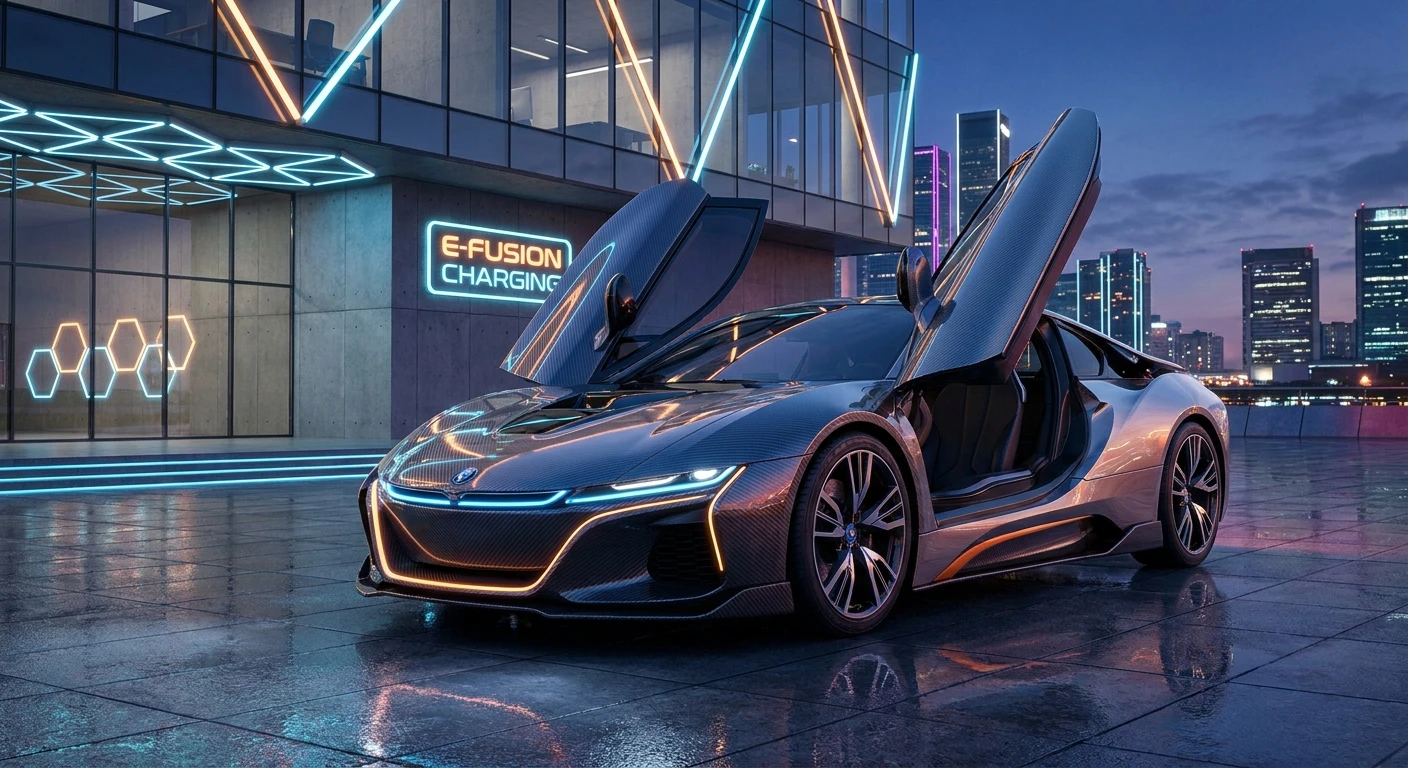
The BMW i8: A Masterclass in Plug-in Hybrid Innovation
When the BMW i8 first debuted on the global stage, it looked like a concept vehicle that had somehow escaped a futuristic laboratory. The BMW i8 fundamentally shifted how enthusiasts and engineers perceive high-performance driving, seamlessly merging aggressive supercar aesthetics with highly efficient plug-in hybrid technology. Rather than relying on massive displacement and tremendous fuel consumption, this visionary machine proved that sheer driving pleasure could coexist with environmental mindfulness. From its sweeping aerodynamic lines to the dramatic dihedral doors, every visual cue serves a functional purpose, directing airflow and minimizing drag while turning heads on every corner. The core thesis behind this vehicle is simple yet profound: you do not have to sacrifice adrenaline-inducing acceleration or razor-sharp handling to embrace a more sustainable automotive future. By integrating a lightweight carbon-fiber tub with an intelligent dual-powertrain system, the manufacturer created a driving dynamic that feels instantly responsive and effortlessly fast. Whether navigating tight urban centers in pure electric silence or conquering winding mountain passes with the combustion engine roaring to life, this car offers a dual personality that few traditional sports cars can match. It stands as a pivotal milestone in automotive history, bridging the gap between the analog past and the electrified future.
Understanding the value proposition of this unique sports car requires looking closely at its dual-powertrain configuration and its remarkably low curb weight. The architecture splits the vehicle into two distinct modules: the Life module, which houses the passenger cell made entirely of carbon-fiber-reinforced plastic, and the Drive module, an aluminum chassis integrating the battery, electric motor, and combustion engine. This structural philosophy completely negates the heavy penalty usually associated with hybrid batteries. The result is a nimble, balanced ride that provides immense grip and cornering stability. The synergy between the front-mounted electric motor and the mid-mounted internal combustion engine grants the driver on-demand all-wheel drive, delivering precise torque vectoring precisely when needed. Let us break down some of the specific advantages of this setup.
Read also: Why the toyota crown 2023 Still Leads the Hybrid Market; The Ultimate Guide to the m340 Performance Sedan; The Ultimate bmw m4 competition Guide.
| Component Feature | Technical Specification | Real-World Impact |
|---|---|---|
| LifeDrive Architecture | Carbon-Fiber Passenger Cell | Dramatically reduces overall curb weight, offsetting the heavy lithium-ion battery pack and improving handling. |
| Plug-In Hybrid Powertrain | 1.5L Turbocharged 3-Cylinder + Electric Motor | Provides instant electric torque at low speeds while delivering high-end horsepower for highway passing. |
| Aerodynamic Exterior | Teardrop Shape and Streamflow Contours | Achieves a drag coefficient of just 0.26, maximizing electric range and high-speed stability. |
To truly grasp the benefits of owning and driving this technological marvel, consider these distinct advantages:
- Unmatched Fuel Efficiency in its Class: Unlike traditional supercars that guzzle premium fuel even while idling in traffic, the hybrid system allows for fully electric commuting. This means you can run daily errands without burning a single drop of gasoline, reserving the combustion engine strictly for spirited weekend drives.
- Instantaneous Acceleration: Because electric motors deliver their maximum torque at zero RPM, pulling away from a standstill feels incredibly urgent. The electric motor fills in the torque gaps while the turbocharger on the combustion engine spools up, resulting in a smooth, uninterrupted surge of power.
- Exotic Aesthetics with Daily Usability: The dramatic butterfly doors and low-slung profile give it a million-dollar hypercar presence. Yet, underneath the wild styling, it remains a comfortable cruiser with a supple suspension setup, modern infotainment, and reliable climate control, making it highly usable for regular driving.
Origins of the Concept
The story begins long before the first production model rolled off the assembly line. The initial spark was ignited by the Vision EfficientDynamics concept, unveiled at the 2009 International Motor Show Germany. At the time, the automotive industry was grappling with strict new emissions regulations and a growing demand for sustainable mobility. The Vision EfficientDynamics was a bold statement of intent, showcasing a radical teardrop shape, fully transparent glass doors, and a three-cylinder turbo-diesel hybrid powertrain. The public reaction was overwhelmingly positive, proving that consumers were hungry for an eco-friendly vehicle that still looked and felt exotic. This enthusiastic reception prompted executives to greenlight a production version, setting off a massive internal engineering effort to translate the wild concept into a road-legal reality.
Evolution of the Production Model
Translating the Vision EfficientDynamics into a viable consumer product required immense technical innovation. Engineers swapped the diesel engine for a high-revving 1.5-liter turbocharged three-cylinder gasoline engine to improve emissions compliance and acoustic appeal. The transparent glass doors were replaced with slightly more conventional, yet still striking, carbon-fiber butterfly doors to meet rigorous side-impact safety standards. The concept was refined through the i8 Concept shown in 2011, and eventually debuted in its final production form in 2013 at the Frankfurt Motor Show. Throughout its production run, the model received various updates, most notably the introduction of the Roadster variant in 2017. The Roadster brought an open-air driving experience, a slightly larger battery capacity, and revised suspension tuning, breathing new life into the lineup and addressing customer requests for a convertible option.
The Modern State and Legacy
Production officially concluded in June 2020 at the Leipzig plant in Germany, marking the end of a highly successful era. With over 20,000 units built, it became the world’s most successful plug-in hybrid sports car of its time. Today, the vehicle enjoys a unique status in the secondary market. It is rapidly transitioning from a depreciating used car into a highly sought-after modern classic. Automotive historians and collectors recognize it as the critical stepping stone that proved performance brands could successfully adopt electrification without losing their soul. As full battery-electric vehicles become the norm, this hybrid pioneer is celebrated for its mechanical complexity, daring design, and the vital role it played in changing public perception regarding electrified performance.
The Carbon Core and Aerodynamics
Diving into the engineering, the most critical element of the vehicle is the Carbon-Fiber-Reinforced Plastic (CFRP) passenger cell. Before this model, carbon fiber was reserved almost exclusively for million-dollar hypercars or dedicated race cars due to the massive cost and time required for manufacturing. By developing a new, highly automated resin injection process, the manufacturer was able to produce CFRP components at scale. This tub is 50 percent lighter than steel and 30 percent lighter than aluminum, yet offers superior torsional rigidity. This stiffness allows the suspension to do its job perfectly without chassis flex, resulting in razor-sharp steering. Wrapped around this carbon core is an exterior dictated entirely by aerodynamics. The layered design, flying buttresses at the rear, and enclosed underbody all work harmoniously to slice through the air, managing thermal cooling for the battery while producing optimal downforce without the need for massive, drag-inducing wings.
Hybrid Powertrain Synergy
The magic of the driving experience lies in the sophisticated software that dictates how the internal combustion engine and electric motor interact. In the rear sits the B38 1.5-liter turbocharged inline-three engine, producing 228 horsepower and driving the rear wheels through a six-speed automatic transmission. In the front, an electric motor producing 129 horsepower drives the front wheels via a two-speed automatic gearbox. A high-voltage lithium-ion battery runs down the center tunnel, keeping the center of gravity incredibly low. When both power units work in tandem, they generate a combined output that launches the car from 0 to 60 mph in a blistering 4.2 seconds.
- Combined Output: 357 horsepower (pre-2018) to 369 horsepower (2018+ models) and 420 lb-ft of torque.
- Electric Range: Approximately 15 to 18 miles of pure electric, emission-free driving depending on the model year and battery size (7.1 kWh to 11.6 kWh).
- Weight Distribution: A near-perfect 50:50 front-to-rear weight distribution, optimizing balance during aggressive cornering.
- Energy Recuperation: Advanced regenerative braking captures kinetic energy during deceleration, actively recharging the high-voltage battery while driving.
- Drive Modes: Intelligent switching between eDrive (pure electric), Eco Pro (maximum efficiency), Comfort (balanced hybrid), and Sport (maximum combined performance).
Step 1: Evaluating Your Charging Setup
If you are planning to bring one of these hybrids into your garage, the first step is preparing your home charging infrastructure. While the vehicle can be charged using a standard 110-volt household outlet, this method is slow and can take overnight to reach a full charge. For the best experience, install a Level 2 (240-volt) charging station. This will replenish the battery from empty to full in roughly two to three hours. Ensuring your battery is topped off every morning guarantees you can utilize the pure electric mode for daily errands, saving fuel and minimizing engine wear.
Step 2: Mastering the Drive Modes
Getting the most out of the driving experience requires an understanding of the intricate drive modes. Start your day in eDrive for silent, smooth neighborhood cruising. When you hit the highway, switch to Comfort mode to let the computer seamlessly juggle electric and gasoline power for maximum efficiency. When approaching a twisty canyon road, push the gear selector to the left to engage Sport mode. This forces the gasoline engine to stay on, stiffens the adaptive dampers, sharpens the steering response, and maximizes regenerative braking to keep the battery charged for boost power.Step 3: Navigating Butterfly Door Maintenance
The spectacular dihedral butterfly doors are a massive part of the appeal, but they require specific care. Always ensure you have adequate clearance before opening them; they swing upward and slightly outward. The gas struts that hold the doors open can wear out over time, especially in colder climates. If the doors become heavy or fail to stay fully open, replace the struts immediately to prevent accidental closures. Additionally, regularly clean and lubricate the door hinges and weather stripping to prevent squeaks and water ingress.
Step 4: Optimizing Battery Conditioning
Lithium-ion batteries perform best when they are kept within a specific temperature window. If you live in an area with extreme winters or scorching summers, utilize the pre-conditioning feature via the smartphone app. While the car is still plugged into the charger, command the system to heat or cool the cabin and the battery pack. This draws energy from the grid rather than the battery itself, ensuring you depart with a fully conditioned battery and maximum electric range.
Step 5: Managing the B38 Three-Cylinder Engine
Because the combustion engine often sits dormant during short electric trips, it is crucial to ensure it gets properly exercised. Oil needs to circulate, and moisture needs to evaporate from the exhaust system. At least once a week, engage Sport mode and take the vehicle for a sustained drive of 20 to 30 minutes. This brings the oil up to optimal operating temperature, preserves the internal seals, and prevents carbon buildup in the turbocharger and combustion chambers. Regular oil changes, strictly following the manufacturer’s time intervals rather than just mileage, are essential.
Step 6: Preserving the Carbon Fiber Tub
The CFRP chassis is incredibly strong but repairing it can be exceptionally difficult and expensive if damaged. When driving, be hyper-aware of steep driveways, speed bumps, and large potholes. Although the ground clearance is better than a traditional supercar, the carbon fiber underbelly is still vulnerable to severe scrapes. If you ever need to have the car lifted for maintenance, ensure the mechanic uses the exact specified jacking points. Lifting the car from the wrong location can crack the carbon fiber structure.
Step 7: Planning for Long-Term Value Retention
As the vehicle transitions into modern classic territory, keeping comprehensive documentation is vital. Keep every service receipt, charging cable, and the original window sticker if possible. Maintain the unique exterior styling by applying a high-quality paint protection film (PPF) to the low nose to prevent rock chips. Stick to OEM (Original Equipment Manufacturer) parts for any repairs, especially concerning the specialized hybrid components and narrow-profile aerodynamically optimized tires. Originality will be the key to commanding a premium on the collector market in the coming decades.
Myth: The BMW i8 is powered by a massive, thirsty V8 engine.
Reality: Despite its aggressive, mid-engine supercar styling, it utilizes a highly efficient 1.5-liter turbocharged three-cylinder engine paired with a robust electric motor. This delivers the acceleration of a V8 while consuming a fraction of the fuel.
Myth: It is extremely slow compared to its rivals.
Reality: With a 0-60 mph time of around 4.2 seconds and instant torque from the electric motors, it is exceptionally quick in real-world driving conditions. It easily outpaces many purely combustion-powered sports cars off the line.
Myth: You cannot drive it if the battery is dead.
Reality: It is a plug-in hybrid, meaning the internal combustion engine will automatically take over and recharge the battery on the go. You are never stranded as long as you have gasoline in the tank.
Myth: The narrow tires mean it has terrible grip.
Reality: While the tires are narrower than those on a standard supercar to improve aerodynamics and rolling resistance, the lightweight carbon chassis, low center of gravity, and all-wheel-drive system provide immense cornering grip and stability.
Myth: It is a fully electric car.
Reality: It is not a pure EV. It has a modest battery pack for short zero-emission trips, but relies on the gasoline engine for sustained high-speed driving and long-distance travel, offering the best of both worlds.
Is the BMW i8 fully electric?
No, it is a plug-in hybrid. It combines a high-voltage battery and electric motor with a traditional internal combustion engine. This setup allows for short trips on pure electricity and long-range driving using gasoline.
Does the BMW i8 have rear seats?
Yes, the coupe version features a 2+2 seating arrangement. However, the rear seats are quite small and are best suited for children, small pets, or additional luggage rather than adult passengers on long journeys. The Roadster version replaces the rear seats with a folding roof mechanism.
What is the top speed of the car?
The top speed is electronically limited to 155 mph (250 km/h). In pure electric mode (eDrive), the maximum speed is limited to 75 mph (120 km/h) to preserve battery range.
When did production end?
The final production models rolled off the assembly line in June 2020. The manufacturer decided to cease production to focus resources on a completely new generation of fully electric vehicles.
How much does the battery cost to replace?
Replacing the high-voltage hybrid battery can be a significant expense, often ranging from $7,000 to $10,000 or more, depending on dealership labor rates. However, these batteries have proven to be highly robust, and complete failures are relatively rare.
Is it an all-wheel-drive car?
Yes, but in a unique way. The electric motor powers the front wheels, while the gasoline engine powers the rear wheels. The computer synchronizes them to provide sophisticated all-wheel-drive traction when both systems are active.
Does it hold its value well?
Like many high-end luxury vehicles, it experienced steep initial depreciation. However, prices have recently stabilized, and excellent condition models are beginning to appreciate slightly as enthusiasts recognize its historical significance and unique driving dynamics.
Can I daily drive this car?
Absolutely. Unlike many exotic sports cars, it features a comfortable suspension setup, excellent visibility, a premium sound system, and reliable climate control, making it a surprisingly practical daily commuter.
Are the butterfly doors heavy to operate?
They are surprisingly light. The doors are constructed from carbon-fiber-reinforced plastic and an aluminum outer skin, making them easy to lift. Gas struts assist with the opening motion, ensuring anybody can easily open and close them.
The BMW i8 remains a stunning achievement in automotive engineering. It bravely challenged the notion that high performance required massive fuel consumption and heavy engines. By pioneering the use of carbon fiber in mass production and seamlessly integrating hybrid technology, it laid the groundwork for the modern era of electrified performance. Whether you are an avid car collector looking for a future classic, or a driving enthusiast seeking a highly unique weekend canyon car, this hybrid supercar offers an experience unlike anything else on the road. Embrace the future of driving and start exploring the secondary market today to find your perfect specification!

Leave a Reply