
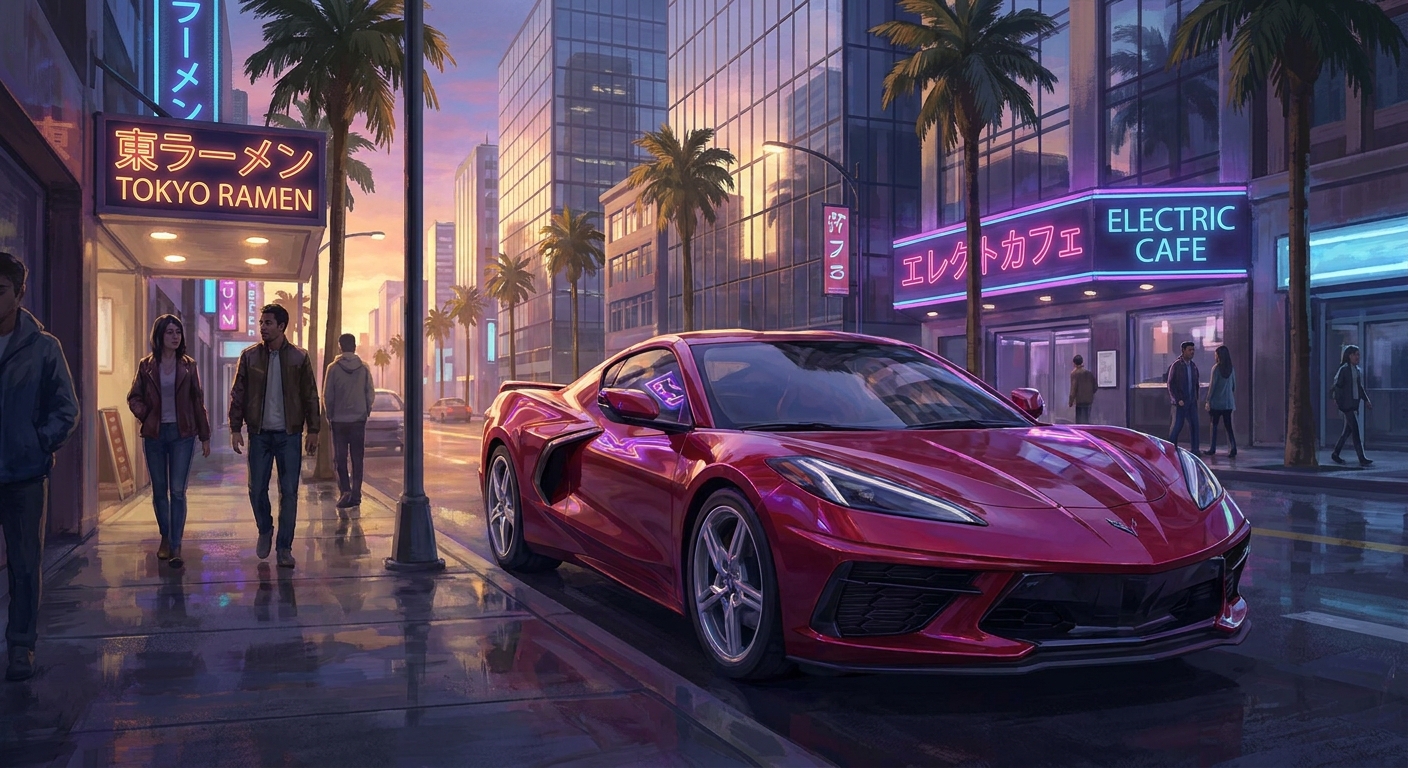
Why the corvette 2024 Changed the Supercar Game Forever
Listen, you cannot talk about modern performance without bringing up the absolute masterclass that is the corvette 2024. I still remember the first time I actually saw one up close in the wild. A buddy of mine managed to import a stunning Torch Red model straight into the heart of Kyiv. We were slowly cruising down the cobblestones near Khreshchatyk Street, dodging those infamous potholes, and the amount of neck-breaking attention that car demanded was purely insane. People were literally stopping their conversations just to hear that naturally aspirated V8 grumble at low RPMs.
The thesis here is simple: this specific model year represents the absolute peak of accessible, mid-engine supercar design. Forget everything you thought you knew about traditional American muscle. This machine completely rewrites the rules of engagement for sports cars, offering a driving experience that rivals European exotics costing three times as much. Whether you are craving raw straight-line acceleration or surgical precision on a curvy mountain road, this vehicle delivers it with zero hesitation. Honestly, it completely bridged the gap between everyday practicality and track-destroying horsepower in a way nobody expected.
Now that we are well into 2026, finding a pristine used one is becoming a genuine challenge because owners simply refuse to sell them. The market knows exactly what this vehicle is worth.
Let’s talk about why this machine totally dominates its class. The core benefit of this generation is the mid-engine layout, which places the heavy V8 engine right behind your head instead of over the front wheels. This shift dramatically improves weight distribution, giving you insane traction off the line and European-level cornering capability. You get two massive value propositions here: daily driving comfort and weekend track day domination. For example, you can comfortably cruise to the grocery store using the softest suspension setting, and then flip a switch to stiffen everything up for a professional track event. Another example is the storage capacity—you actually get both a traditional trunk in the back and a ‘frunk’ (front trunk), meaning two sets of golf clubs fit without a single issue.
| Feature | The 2024 American Icon | German Rival (911 Carrera) |
|---|---|---|
| Engine Placement | Mid-Engine V8 | Rear-Engine Flat-6 |
| Horsepower | 490 – 495 HP | 379 HP |
| Base Price Value | Highly Accessible | Premium Luxury Taxed |
If you really want to maximize your ownership experience, you need to follow a few core principles. Here is how you get the most out of your ride:
- Master the Drive Modes: Spend a full week driving exclusively in Weather, Tour, Sport, and Track modes to understand exactly how the steering weight and throttle response change.
- Utilize the Front Lift System: Program your GPS to automatically lift the front nose of the car at specific steep driveways or brutal speed bumps you encounter daily.
- Customize Z-Mode: Map your favorite engine sound, steering feel, and suspension stiffness to the silver Z button on your steering wheel for instant access to your perfect setup.
The Origins of the Great American Sports Car
To truly appreciate what you are driving, you need to know where it came from. The story starts way back in 1953 when the very first generation rolled off the assembly line. Honestly, those early cars were visually stunning but lacked the raw performance to back up their aggressive looks. They featured an inline-six engine and a two-speed automatic transmission that felt incredibly sluggish. It wasn’t until a legendary engineer named Zora Arkus-Duntov got his hands on the project that a V8 was introduced, forever altering the trajectory of the brand. Zora always dreamed of putting the engine behind the driver, but the technology and budget of the era just wouldn’t allow it. For decades, the front-engine layout became the standard, getting more powerful and refined with every passing generation.
Evolution into the Mid-Engine Era
Fast forward through decades of pop-up headlights, fiberglass bodies, and massive superchargers. The front-engine design had essentially reached its physical limits. You can only put so much horsepower through the rear wheels of a front-engine car before physics takes over and traction completely fails. The massive shift happened with the C8 generation. The engineers finally executed Zora’s long-standing dream. The transition wasn’t just a slight modification; it required tearing up the blueprints and starting entirely from scratch. The chassis, the dual-clutch transmission, and the entire aerodynamic profile were completely reimagined to support this new weight distribution.
Modern State and the C8 Milestone
That brings us to the specific brilliance of the current iterations. After the initial shock of the mid-engine redesign wore off, the engineering team spent the next few years quietly perfecting the formula. By the time this specific model year dropped, they had ironed out all the early production quirks. The interior materials felt substantially more premium, the infotainment software bugs were squashed, and the exhaust tuning reached a level of acoustic perfection. It stands today as a monumental milestone—a fully matured, highly refined supercar that proudly punches way above its weight class.
Aerodynamics and Downforce Mechanics
Let’s get slightly nerdy for a second. The shape of this car isn’t just for turning heads at gas stations; it is a highly functional aerodynamic tool. When you are pushing high speeds, normal cars experience ‘lift,’ which makes the steering feel dangerously light and disconnected. The aggressive front splitter and the rear wing work perfectly together to generate actual downforce. This means the faster you drive, the harder the surrounding air pushes the car into the pavement. The side scoops you see behind the doors aren’t fake plastic vents—they actively channel massive amounts of cold air directly into the engine bay to keep the V8 from overheating, while simultaneously reducing aerodynamic drag along the sides of the vehicle.
Powertrain and Magnetic Ride Control
Underneath the glass hatch sits an absolute marvel of modern engineering: the LT2 naturally aspirated V8 engine. It breathes deeply without relying on turbochargers, which means you get instant throttle response. But the real magic trick is the Magnetic Selective Ride Control system. The shock absorbers are filled with a special fluid containing tiny metallic particles. An electronic system shoots magnetic currents through this fluid up to 1,000 times per second, instantly changing the viscosity. This means the suspension can switch from feeling like a plush luxury sedan to a rock-hard race car in less time than it takes to blink.
- The Tremec 8-speed dual-clutch transmission executes gear shifts in literally milliseconds without interrupting torque delivery.
- A dry-sump oil system ensures the engine never starves for oil during extreme high-G cornering on the track.
- The chassis structure utilizes high-pressure die-cast aluminum parts, resulting in an incredibly rigid frame that eliminates body roll.
- Active fuel management allows the V8 to seamlessly shut down four cylinders during highway cruising to drastically improve fuel economy.
Day 1: The Delivery and Initial Inspection
Taking delivery of a machine like this is an event you will never forget. Do not rush this process. Walk around the entire vehicle with a highly critical eye. Check the panel gaps, inspect the massive wheels for any transit scratches, and ensure the dealer hands over both key fobs. Take a deep breath, sink into those aggressively bolstered GT2 bucket seats, and just absorb the smell of the leather. Your only goal today is driving it safely home and parking it in your garage.
Day 2: Breaking in the Engine Gently
I know the temptation to floor the accelerator is overwhelming, but you absolutely must respect the 500-mile break-in period. During this time, the engine redline is digitally limited to prevent catastrophic damage to the internal components. Drive it around your local town, vary your engine speeds constantly, and avoid aggressive braking. This ensures the piston rings seat perfectly.
Day 3: Mastering the Infotainment System
Grab a coffee, sit in the garage, and turn on the accessory mode. Connect your smartphone via wireless Apple CarPlay or Android Auto. Dive deeply into the menus to configure your digital dashboard layout. You can choose different gauge clusters depending on your mood—set up the Track layout with the massive tachometer in the center for when you want to feel like a racing driver.
Day 4: Exploring Z-Mode and Custom Settings
This is where the fun really begins. Z-Mode is your personalized driving profile. Go into the settings and crank the engine sound to the loudest track setting, keep the suspension in the softest tour setting for comfort, and put the steering weight somewhere in the middle. Hit that silver Z button on the wheel, and feel the car instantly transform into your exact specifications.
Day 5: Your First Highway Cruise
Take it out onto the open interstate. This is where you test the GT (Grand Touring) capabilities of the car. Turn on the cruise control, let the engine drop into V4 mode, and blast your favorite playlist through the premium Bose sound system. You will be genuinely shocked at how incredibly quiet and composed the cabin is at highway speeds.
Day 6: Paint Protection and Ceramic Coating
Because the nose of this car sits so incredibly low to the ground, it acts like a vacuum for rocks and road debris. Spend the money to get a high-quality Paint Protection Film (PPF) applied to the front bumper, hood, and side mirrors. Follow it up with a professional ceramic coating so that washing it in the future simply requires a quick spray down with a hose.
Day 7: Hitting the Local Track
Assuming you have passed the break-in period and safely changed the oil, it is finally time to unleash the beast. Find a local autocross event or an open track day. Drop the tire pressures slightly, put the car into full Track mode, and feel the violent, beautiful rush of lateral grip. This is exactly what the engineers built the car to do.
Myth: It is just a straight-line muscle car that cannot handle corners.
Reality: Thanks to the mid-engine architecture and insane chassis rigidity, it easily keeps pace with elite European sports cars on twisty technical tracks.
Myth: You cannot possibly daily drive a low-slung supercar.
Reality: With features like the GPS-enabled front lift system, massive dual storage trunks, and soft suspension settings, it is honestly as easy to drive to the store as a standard sedan.
Myth: The maintenance and repair costs will totally bankrupt you.
Reality: At the end of the day, it is still manufactured by Chevrolet. Parts are wildly accessible, oil changes do not require a specialized exotic car mechanic, and the overall reliability is outstanding.
Myth: It is too difficult to see out of the rear window.
Reality: The high-definition digital rear-view mirror completely eliminates rear blind spots by streaming a live ultra-wide camera feed directly to your mirror.
How fast does it go from 0 to 60?
When equipped with the Z51 performance package and utilizing the launch control system, you can consistently hit 60 mph in a blistering 2.9 seconds. It is violently fast.
Is the front lift system truly necessary?
Absolutely. Unless you live in perfectly flat terrain with zero speed bumps or steep driveways, the front lift system will save your front splitter from incredibly expensive scraping damage on a daily basis.
What is the absolute top speed?
If you find a long enough stretch of closed road, the standard model will max out at an aerodynamic drag-limited 194 mph.
Can I honestly fit my golf clubs in the trunk?
Yes. The rear trunk was specifically designed by the engineers to securely hold two standard-sized golf bags side-by-side.
Does it come with a manual transmission option?
No, and it never will. The 8-speed dual-clutch transmission shifts significantly faster than any human ever could with a stick shift, though you can use the paddle shifters for full manual control.
What kind of gas does it specifically require?
You need to use Premium unleaded fuel (91 octane or higher) to prevent engine knock and ensure you are getting the full horsepower output promised by the factory.
Is the exhaust sound too loud for quiet neighborhoods?
Not if you are polite. You can actually program the exhaust valves to start up in ‘Stealth Mode,’ which heavily muffles the V8 bark so you don’t wake up your neighbors at 6 AM.
Look, whether you are trying to set lap records or just want the ultimate weekend cruiser, this vehicle absolutely delivers on every single front. It changed the landscape of the automotive industry by proving that world-class performance doesn’t have to cost half a million dollars. Drop a comment below if you own one or are currently hunting for one—and make sure to share this post with your car buddies who still think European cars are the only way to go fast!

Leave a Reply