
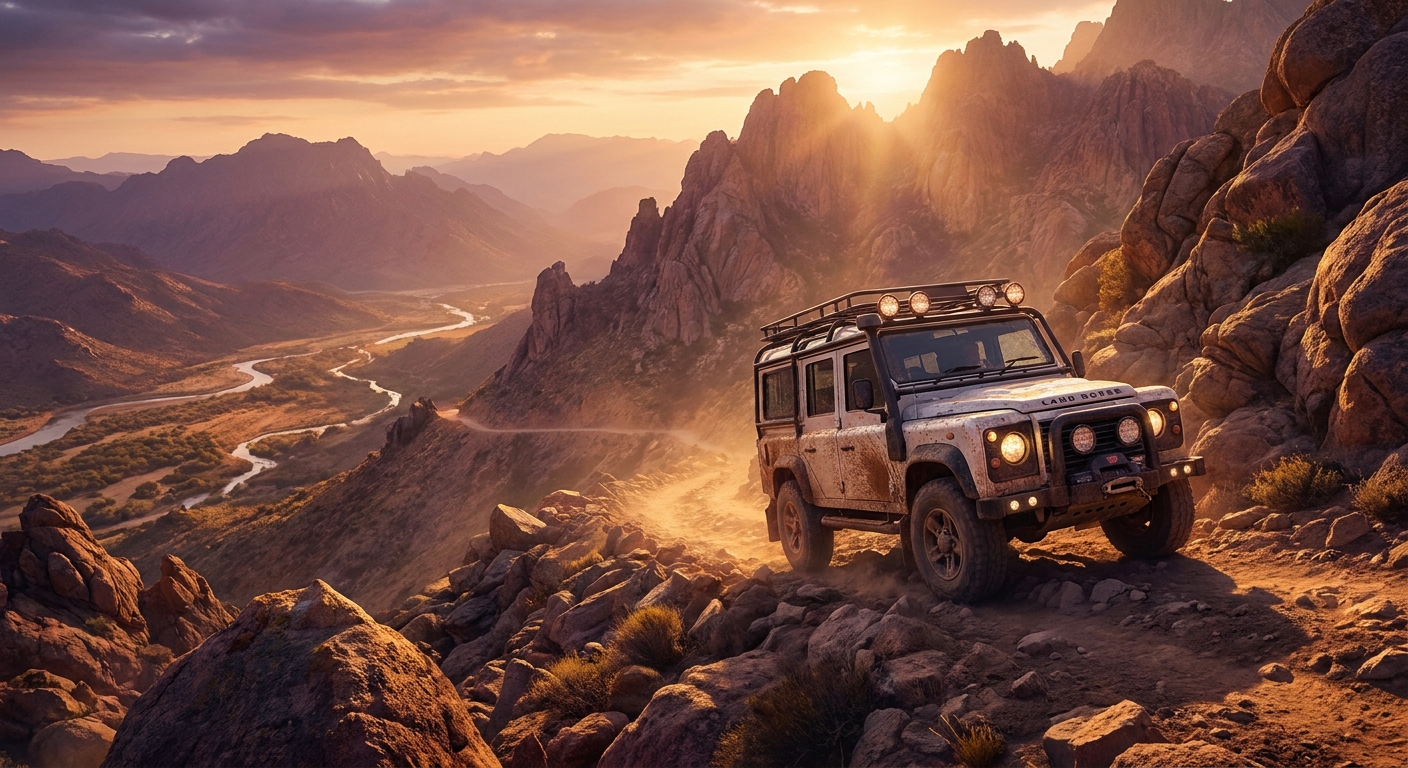
Why the land rover defender Is Still the Ultimate Machine
You know what absolutely blew my mind the first time I got behind the wheel of a land rover defender? It completely rewrites the rules of what an off-road vehicle should feel like. Listen, I have driven almost every 4×4 out there, but this thing just hits differently. Last month, I took one deep into the Carpathian mountains here in Ukraine, right past Yaremche. The rain was pouring down in sheets, turning the steep dirt logging tracks into a slick, treacherous ribbon of wet clay. Ordinary off-roaders would have spun out, begged for mercy, or required an immediate winch recovery. But not this machine. It grabbed the mud like it had actual claws, calculating traction multiple times a second while I sat inside listening to crisp audio in pure comfort. The cabin was eerily quiet, completely isolated from the chaos outside.
That is the real magic of this vehicle. It provides an unmatched blend of brute mechanical capability and sophisticated modern luxury. You do not have to choose between a rugged trail conqueror and a comfortable family hauler anymore. Now that we are well into 2026, automotive technology has advanced rapidly, yet this specific model remains the absolute benchmark. I want to tell you exactly how it manages this dual personality, breaking down the mechanics, the history, and how you can push it to the absolute limit yourself.
The Core Capability: Beyond the Spec Sheet
Let us talk about what actually happens when you push the throttle on a rugged trail. The capability of this machine goes far beyond just having high ground clearance. It relies on a highly advanced aluminum monocoque architecture that is reported to be three times stiffer than traditional body-on-frame designs. When you are articulating over massive boulders, that stiffness translates to zero cabin flex. No squeaks, no groans, just solid forward momentum. The value proposition here is simple: you are buying ultimate peace of mind. For example, if you are tackling a rutted-out forest trail, the vehicle automatically adjusts its ride height to clear obstacles. Conversely, if you are cruising down the highway at top speed, it lowers itself for better aerodynamics and fuel efficiency.
Here is a quick breakdown of how the different iterations stack up:
| Model/Generation | Key Engineering Feature | Best Real-World Application |
|---|---|---|
| Classic Series/Defender (Pre-2016) | Solid axles, basic mechanics | Agricultural work, vintage collecting, raw mechanical off-roading |
| Modern L663 (Coil Spring) | Stiff aluminum unibody, pure analog feel | Daily driving with frequent moderate trail use |
| Modern L663 (Air Suspension) | Adaptive dynamics, height adjustability | Extreme rock crawling, deep water wading, luxury touring |
Why exactly does it crush the competition? Here are the three main reasons:
- Unbeatable Geometry: The incredibly short front and rear overhangs give it approach and departure angles that most modified rigs can only dream of. You can literally drive up to a vertical wall and put the front tires on it before the bumper even scrapes.
- Intelligent Traction: The computerized terrain management systems act like a highly experienced spotter living inside the dashboard. It adjusts throttle sensitivity, differential locking, and transmission mapping based on the exact surface beneath the tires.
- Everyday Usability: Unlike purpose-built rock crawlers that wander all over the highway and rattle your teeth out, this drives beautifully on the tarmac. You can drop the kids off at school in total comfort and immediately hit a Class 4 off-road trail without changing a single thing.
The Muddy Origins
To really appreciate what this vehicle is today, you need to understand where it started. Right after the Second World War, the Rover Company needed a lifeline. Steel was severely rationed, but surplus aluminum from aircraft manufacturing was plentiful. Maurice Wilks famously sketched the original design in the sand on a beach in Wales. The idea was to create a light agricultural utility vehicle that could do the work of a tractor but also be driven on the road. The Series I launched in 1948 and immediately became a massive success. Farmers, explorers, and military forces realized it was virtually indestructible.
Evolution Through the Decades
As the decades rolled by, the design slowly morphed. We saw the Series II and III, which introduced slightly more refined styling and better engines, but the core formula never wavered. By the 1980s, the company introduced the 90 and 110 models, referring to the wheelbase lengths in inches. This is when the permanent four-wheel drive system and coil springs revolutionized its ride quality. The name itself was not officially adopted until 1990, right around the time the Discovery was launched, to avoid confusion across the brand’s expanding lineup. For years, the silhouette remained virtually unchanged, becoming an absolute global icon recognized from the jungles of South America to the savannas of Africa.
The Modern State of the Legend
Fast forward to the introduction of the L663 generation, and purists initially panicked. The loss of solid axles and the body-on-frame setup caused massive controversy. However, reality quickly silenced the critics. The modern iteration proved it could out-perform the classic models in literally every single metric. Now, in 2026, it represents the absolute pinnacle of adventure vehicles. It retains the rugged, blocky styling cues of its ancestors—like the alpine light windows and side-hinged rear tailgate—but packs them with the kind of computing power normally found in aerospace engineering.
The Pivi Pro Brain and Air Suspension
Let us get a bit technical, but I promise to keep it grounded. The central nervous system of the vehicle is the Pivi Pro infotainment setup. This is not just a screen for your music; it controls the vehicle’s dynamic behavior. It operates on its own dedicated battery, meaning the moment you sit in the driver’s seat, the system is fully awake and ready. It runs highly complex algorithms to manage the electronic air suspension. The air struts can lift the body to provide an incredible 11.5 inches of ground clearance. If the system detects that the vehicle is bottoming out on an obstacle, it automatically provides an extra burst of lift to get you unstuck. It is literally engineering magic happening in milliseconds.
Terrain Response System Demystified
The Terrain Response system is where the true capability lies. Instead of you needing to know exactly when to lock a center differential or engage low range, the vehicle does the heavy lifting. You simply select the surface you are driving on—mud, ruts, sand, rock crawl, or wade—and the computer instantly calibrates the vehicle’s mechanics.
- Wading Depth: The vehicle can safely cross water up to 35.4 inches deep, utilizing sonar sensors in the mirrors to warn you if the water gets too close to the intake.
- Torque Vectoring by Braking: It constantly monitors wheel slip. If one wheel loses traction, the system pinches the brake on that specific wheel, forcing engine torque to the wheels with actual grip.
- ClearSight Ground View: Cameras stitch together a feed to make the hood effectively invisible on the screen, letting you see the exact placement of your front tires over jagged rocks.
- Twin-Speed Transfer Box: It provides ultra-low gearing, giving you absolute control for steep descents without needing to ride the brakes.
Day 1: Basecamp Preparation and Tarmac Testing
If you want to truly master this machine, you need a plan. Here is a 7-day training guide I use when bringing friends into the off-road lifestyle. Day 1 is all about understanding the baseline. Before hitting the dirt, spend hours on the tarmac. Feel how the steering reacts at highway speeds. Test the adaptive cruise control and lane keep assist. Familiarize yourself with the exact dimensions of the vehicle, using the 3D surround camera to park in tight spots. You need to build muscle memory for where the corners of the vehicle are.
Day 2: Mud Ruts and Slippery Surfaces
Head to a local trail after a solid rainstorm. Select the ‘Mud and Ruts’ setting. You will immediately feel the steering become a bit heavier and the throttle response soften to prevent wheel spin. Keep a steady, constant momentum. The key here is not speed, but consistency. Let the traction control figure out the slip; if you hear grinding noises from the brakes, that is just the system actively managing torque. Trust the computers.
Day 3: Water Crossings
Find a shallow, safe river crossing with a hard bottom. Engage the ‘Wade’ mode. This setting automatically raises the ride height, softens the throttle, and recalculates the climate control to stop pulling in outside air. Enter the water slowly to create a gentle bow wave in front of the bumper, and maintain exactly that speed. Do not stop in the middle of the river. Once you exit, the vehicle will automatically lightly apply the brakes to wipe the rotors dry.
Day 4: High Altitude Rock Crawling
Time to find some serious inclines. Drop the transmission into low range and select ‘Rock Crawl’. This locks the center differential and heightens the suspension to its maximum. Approach boulders slowly, using the ClearSight camera system to place your tires directly onto the highest points of the rocks to maintain underbody clearance. Practice left-foot braking—keeping one foot on the brake while applying throttle with the other—to smooth out your movements over jarring drops.
Day 5: Sand and Loose Dynamics
If you can find a beach or a sandy quarry, this is where you learn momentum. Air your tires down to about 15-18 psi. Select ‘Sand’ mode, which totally changes the gearbox mapping to hold gears longer and sharpens the throttle response. In sand, wheel speed is your best friend. If you feel the vehicle starting to sink, do not brake hard; gently coast to a stop to avoid digging a rut that you cannot reverse out of.
Day 6: Recovery Tactics
Even the best get stuck. Dedicate this day to learning how to use recovery boards, kinetic snatch straps, and the integrated recovery points on the frame. Understand the difference between a static tow strap and a kinetic rope. Practice deploying your gear safely, ensuring all passengers are standing far back from the recovery zone. Knowing you have the skills to self-recover gives you the confidence to push further.
Day 7: The Wash Down and Inspection
Off-roading is not over until the vehicle is clean. Spend the final day rigorously washing the undercarriage. Mud left trapped in the suspension components can throw off wheel balance and trap moisture against the aluminum. Inspect your tire sidewalls for cuts, check your fluid levels to ensure no water contamination occurred through the breathers, and reset your tire pressures to normal highway specifications.
Separating the Machine from the Myths
Myth: Modern electronics make off-roading too dangerous because if a computer fails, you are stranded.
Reality: The systems are incredibly redundant. Modern wiring harnesses are heavily sealed against water and dust. The truth is, mechanical parts like axles and differentials break far more often under extreme stress than a solid-state computer module ever will. Plus, default fail-safes allow you to limp home even if a sensor goes bad.
Myth: You need massive aftermarket mud tires to do real off-roading.
Reality: A high-quality all-terrain tire paired with a modern traction control system will outperform an aggressive mud-terrain tire on 90% of surfaces, while saving you from horrible road noise and terrible fuel economy on your daily commute.
Myth: The unibody construction is too weak for hardcore trails.
Reality: This aluminum monocoque has been torture-tested with repeated impacts that would literally bend older ladder-frame chassis. It is the strongest body structure the brand has ever produced.
Answering Your Biggest Questions
Is it a practical daily driver?
Absolutely. The air suspension makes it ride smoother than most luxury sedans, and the visibility is fantastic.
Which engine option makes the most sense?
The inline-six mild hybrid is the sweet spot. It offers excellent torque for the trails and perfectly smooth acceleration on the highway without the massive fuel consumption of the V8.
How does it handle extreme winter conditions?
With proper winter tires, it is virtually unstoppable. The snow/gravel/grass mode adjusts the torque delivery so smoothly that you barely feel the ice underneath you.
What is the real-world fuel economy?
It is a heavy, boxy machine. You can expect average numbers, but nobody buys a highly capable brick for its aerodynamic fuel savings. It is about the utility.
Can it comfortably tow a heavy trailer?
Yes, it has a massive towing capacity, often exceeding 8,000 lbs depending on the engine. The advanced tow assist uses the rear cameras to help you reverse with a trailer perfectly.
How difficult is it to update the software?
It features over-the-air updates. Just connect it to your home Wi-Fi, and it downloads improvements exactly like your smartphone does.
Do I need to lift it for larger tires?
No, the factory air suspension provides more than enough clearance. Slapping a cheap aftermarket lift on it will ruin the carefully calibrated geometry.
Ultimately, getting behind the wheel of this machine changes your perspective on travel. You stop looking at maps for the fastest route and start looking for the dirt tracks that nobody else dares to take. The land rover defender is not just a method of transportation; it is an enabler of massive adventures. So do not just read about it—head down to your local specialist, book a test drive, and feel that immense capability for yourself today!

Leave a Reply