
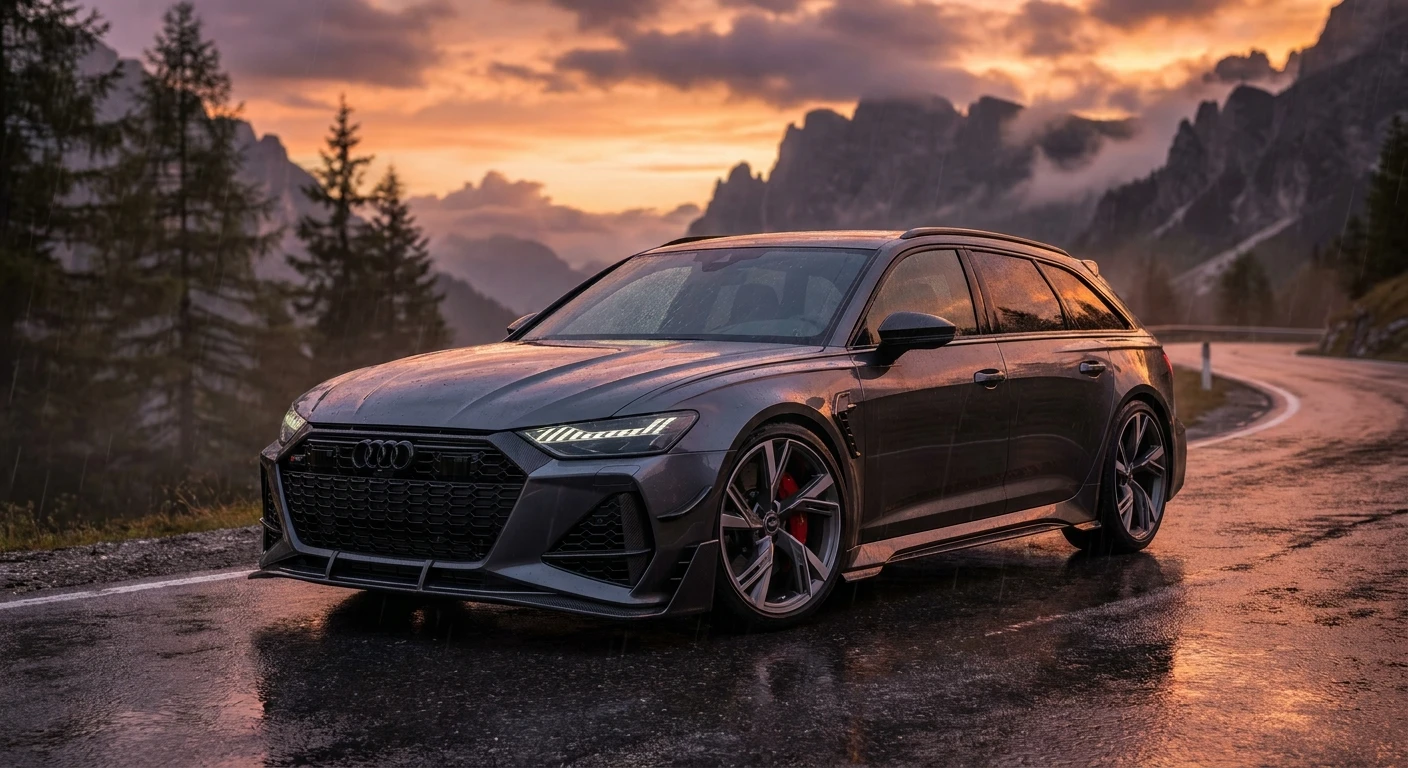
The Audi RS6 GT: Redefining High-Performance Estate Cars
If you are tracking the evolution of ultra-high-performance wagons, the RS6 GT stands as an absolute masterpiece of automotive engineering. Introduced as the ultimate swansong for the internal combustion C8 generation, this highly limited estate car brings race-inspired dynamics to a practical family silhouette. Built in a strictly limited production run of just 660 units globally, this vehicle represents the pinnacle of what engineers at Audi Sport can achieve when given the freedom to push boundaries. Rather than simply adding power, the development team focused intensely on weight reduction, aerodynamic balance, and suspension geometry to create a vehicle that responds with the urgency of a dedicated supercar while retaining the cargo capacity of a premium wagon. Enthusiasts revere this specific model because it directly references the legendary Audi 90 quattro IMSA GTO race car, translating aggressive track-focused aesthetics into street-legal reality. The wide-body stance, completely bespoke carbon fiber body panels, and manual coilover suspension demonstrate a profound commitment to driving purity. Understanding the mechanical brilliance of this wagon requires looking closely at the specific modifications that separate it from the standard production models and elevate it into the realm of modern automotive legends.
The core philosophy behind this limited-edition machine revolves around stripping away unnecessary mass while maximizing mechanical grip. The value proposition is clear: deliver an uncompromising driving experience that bridges the gap between grand touring comfort and aggressive circuit capability. For instance, an owner can drive the car across continents with standard luggage, yet seamlessly transition to setting blistering lap times at the Nürburgring without changing anything other than tire pressures. Another primary example is the visual distinction; the bespoke pass-through rear wing and integrated carbon front fenders instantly signal its exclusivity at any high-end automotive gathering.
Read also: BMW M3 CS: Pure Performance Specs and Track Guide; Acura TLX Type S: Performance, Specs, and Reviews; The Ultimate Guide to the m340 Performance Sedan.
| Specification Metric | Standard RS6 Avant | The GT Edition |
|---|---|---|
| Suspension Architecture | Adaptive Air Suspension | Adjustable Manual Coilovers |
| Body Panel Material | Steel and Aluminum | Extensive Carbon Fiber |
| Rear Differential Tune | Standard Sport Setting | Bespoke Rear-Biased Setup |
The extensive engineering upgrades are not merely cosmetic; they represent a fundamental shift in how the vehicle handles dynamic loads. By integrating motorsport-derived components, the chassis response becomes significantly more communicative.
- Bespoke Carbon Fiber Hood and Fenders: Completely redesigned to shed significant weight from the front axle, improving turn-in response and reducing understeer during aggressive cornering.
- Adjustable Coilover Suspension System: Factory-installed mechanical suspension lowering the ride height by 10mm, featuring higher spring rates and manually adjustable dampers for precise track tuning.
- Revised Quattro Sport Differential: Specifically reprogrammed to send more power to the rear wheels under heavy acceleration, allowing for throttle-adjustable cornering trajectories.
- Exclusive Aerodynamic Enhancements: A unique double-wing rear spoiler and a completely modified front splitter work in tandem to increase high-speed downforce and overall stability.
Origins of the RS Estate
The lineage of high-performance Audi wagons traces back to the legendary RS2 Avant of the mid-1990s. Developed in collaboration with Porsche, the RS2 proved that a utilitarian five-door body style could house a turbocharged engine capable of outrunning contemporary sports cars. This foundational concept established a unique market segment where practicality and extreme speed coexisted. Over the decades, engineers continuously refined this formula, moving from inline-five engines to twin-turbocharged V6s, and eventually to the thunderous V8 powerplants that define modern super estates. The philosophy always centered around the Quattro all-wheel-drive system, ensuring that massive horsepower outputs remained usable in all weather conditions.
Evolution to the C8 Generation
When the C8 generation arrived, it completely shattered previous design constraints. Earlier models often featured subtle “sleeper” aesthetics, but the C8 adopted a radically widened track, bulging blister fenders, and an aggressive front fascia shared with the RS7. The introduction of 48-volt mild-hybrid technology and cylinder-on-demand efficiency systems proved that immense power could be paired with intelligent thermal and energy management. The standard C8 became a global phenomenon, gaining immense popularity among enthusiasts who demanded supercar performance alongside daily usability. However, as the automotive industry began pivoting aggressively toward electrification, the engineering team realized they needed one final, uncompromised iteration of the pure internal combustion formula.
The Modern State of Super Wagons
The culmination of this rich history led directly to the development of the 660-unit limited run. Inspired by an apprentice project that paid homage to the 1989 IMSA GTO race car, management greenlit a production model that would serve as the ultimate expression of the platform. The modern state of the super wagon market demands exclusivity, track capability, and striking aesthetics. By outfitting the chassis with components typically reserved for dedicated track cars—such as manual coilover dampers and extensive carbon fiber bodywork—this special edition secures its place as the definitive, ultimate expression of the brand’s high-performance estate legacy.
Powertrain and Turbocharger Dynamics
Beneath the aggressive carbon fiber hood lies a masterclass in thermal dynamics and fluid engineering. The 4.0-liter twin-turbocharged V8 engine features a “hot V” configuration, where the two twin-scroll turbochargers sit nestled inside the valley of the cylinder banks. This specific arrangement minimizes the distance exhaust gases must travel before spooling the turbine wheels, virtually eliminating turbo lag and ensuring instantaneous throttle response. The engine calibration features higher boost pressures and optimized fuel mapping, generating massive torque across a highly usable powerband. Engineers also removed sound-deadening materials between the engine bay and the cabin, allowing the raw mechanical symphony of the V8 to dominate the driving experience without synthetic enhancement.
Aerodynamics and Advanced Materials
The aerodynamic profile represents a significant departure from standard production methodologies. Every modified surface serves a distinct functional purpose regarding airflow management or thermal extraction. The massive front intakes channel ambient air directly into the heat exchangers, while integrated vents behind the front wheels relieve high-pressure zones within the wheel wells, thereby reducing aerodynamic lift and increasing front-end grip at high velocities.
- The carbon fiber front fenders are completely bespoke, featuring integrated air outlets that reduce drag and cool the massive ceramic brake rotors.
- The suspension system utilizes three-way adjustable dampers with significantly stiffer anti-roll bars, increasing lateral rigidity by 30 percent over standard air setups.
- Ceramic composite braking systems come standard, capable of operating at extreme temperatures exceeding 1,000 degrees Celsius without exhibiting brake fade.
- Forged 22-inch milled wheels are designed specifically for weight reduction, drastically lowering the unsprung mass for faster suspension reaction times.
- The Quattro all-wheel-drive system features a self-locking center differential that can direct up to 85 percent of the engine’s torque exclusively to the rear axle when slip is detected.
Step 1: Adjusting the Coilover Suspension
When preparing for a high-performance driving session, mastering the mechanical suspension is crucial. Unlike air-ride systems that adjust via a dashboard button, the manual coilovers require physical adjustments. Use the provided tool kit to dial in the rebound and compression settings based on the track surface. For smooth circuits, increase the compression damping to reduce body roll during rapid direction changes. Always ensure left and right sides are mirrored perfectly.
Step 2: Optimizing Tire Pressures
High-speed cornering generates immense heat, causing tire pressures to spike dramatically. Start your session with lower cold pressures—typically around 30 to 32 psi. As the tires heat up over a few warm-up laps, the pressure will rise into the optimal operating window of 38 to 40 psi. Monitor the onboard telemetry constantly to prevent over-inflation, which reduces the contact patch and compromises grip.
Step 3: Dialing in the Rear Differential
Through the drive select menu, configure the RS mode to maximize the sport differential’s aggressive mapping. Set the differential to “Dynamic” to ensure the system actively over-drives the outside rear wheel during cornering. This mechanical torque vectoring essentially rotates the heavy wagon around its center axis, neutralizing the natural tendency to understeer on corner entry.
Step 4: Warming up the Carbon Ceramic Brakes
Carbon ceramic brake rotors require significant heat to function optimally. During your out-lap, perform several firm, progressive braking maneuvers from moderate speeds to build temperature in the rotors and pads. Never dive into the first heavy braking zone on cold ceramics, as the initial bite will be severely reduced compared to traditional steel brakes.
Step 5: Utilizing Launch Control Parameters
To achieve maximum acceleration from a standstill, the launch control system must be engaged correctly. Ensure the steering wheel is perfectly straight, switch the ESC to “Sport” mode, hold the brake firmly with your left foot, and pin the throttle to the floor. The engine will hold at the optimal RPM. Release the brake abruptly, allowing the Quattro system to violently distribute torque across all four contact patches.
Step 6: Managing Cooling on High-Speed Runs
Even with enhanced thermal management, a heavy twin-turbo V8 generates massive heat during sustained track usage. Pay close attention to oil and coolant temperatures displayed on the virtual cockpit. If oil temperatures approach the upper limits, execute a cool-down lap by shifting early, minimizing brake usage, and keeping speeds high enough to force ambient air through the front radiators.
Step 7: Post-Track Day Maintenance
After your driving session concludes, avoid applying the parking brake while the rotors are still blazing hot, as this can cause pad material to fuse to the disc. Drive smoothly at highway speeds to properly cool the drivetrain. Inspect the tires for severe graining, clean the brake dust from the forged wheels immediately to prevent pitting, and check all fluid levels once the engine returns to normal operating temperatures.
Myth: The aggressive exterior styling is just a cosmetic package without any real mechanical benefits.
Reality: The exterior modifications are deeply functional. The pass-through roof spoiler generates actual downforce, the vented carbon fenders reduce high-pressure air buildup in the wheel wells, and the carbon fiber hood significantly lowers the center of gravity and front axle weight.
Myth: A heavy wagon cannot genuinely handle like a precision track car.
Reality: Thanks to the bespoke manual coilover suspension, higher spring rates, and a re-tuned rear-biased differential, the chassis dynamics completely defy its curb weight, offering razor-sharp turn-in and predictable mid-corner rotation.
Myth: You can easily buy these components and upgrade a standard wagon to perfectly match this specification.
Reality: Many components, including the carbon fiber body panels, bespoke suspension tuning, and specific software calibrations for the transmission and differential, are highly proprietary to the 660 units produced and cannot be simply bolted onto standard models.
How much horsepower does the engine produce?
The twin-turbocharged 4.0-liter V8 generates a massive 630 horsepower and 850 Nm of torque, matching the output of the Performance variant while benefiting from reduced overall vehicle weight.
How many units were built globally?
Production is strictly capped at exactly 660 individually numbered units worldwide, ensuring massive exclusivity and future collector status.
Can you adjust the suspension from inside the cabin?
No, the specialized coilover suspension is manually adjustable. Owners must use physical tools provided with the vehicle to change ride height, compression, and rebound settings.
Is the hood actually made of carbon fiber?
Yes, the entire hood is constructed from exposed and painted carbon fiber, drastically reducing weight over the front wheels to improve steering feel.
Does the car feature rear-wheel steering?
Yes, the dynamic all-wheel steering system is retained, turning the rear wheels in the opposite direction of the fronts at low speeds for agility, and in the same direction at high speeds for stability.
What is the top speed of the vehicle?
With the factory limiters adjusted for this specific model, it can achieve a blistering top speed of 190 mph (305 km/h) on closed circuits.
Are the racing decals mandatory?
Buyers had the option to choose specific heritage decal packages inspired by historic race cars, but they could also order the vehicle in solid colors for a stealthier appearance.
Can it still be used as a practical daily driver?
Absolutely. Despite its track-focused mechanicals, it retains the full cargo capacity of the standard estate, comfortable seating for five, and a luxurious cabin packed with advanced infotainment technology.
The RS6 GT is much more than a fast wagon; it is a meticulously engineered tribute to Audi’s motorsport heritage. By combining raw V8 power, advanced lightweight materials, and highly analog suspension tuning, it delivers a driving experience that completely redefines the boundaries of practical performance. If you want to experience the zenith of internal combustion engineering before the electric era fully takes over, securing time behind the wheel of this limited masterpiece is an absolute necessity. Check out local high-end auctions or specialized performance dealers today to track down one of these 660 rare machines!

Leave a Reply